Home › Field notes › Hook-and-Loop Module Mounting: Shear, Peel and Service Life
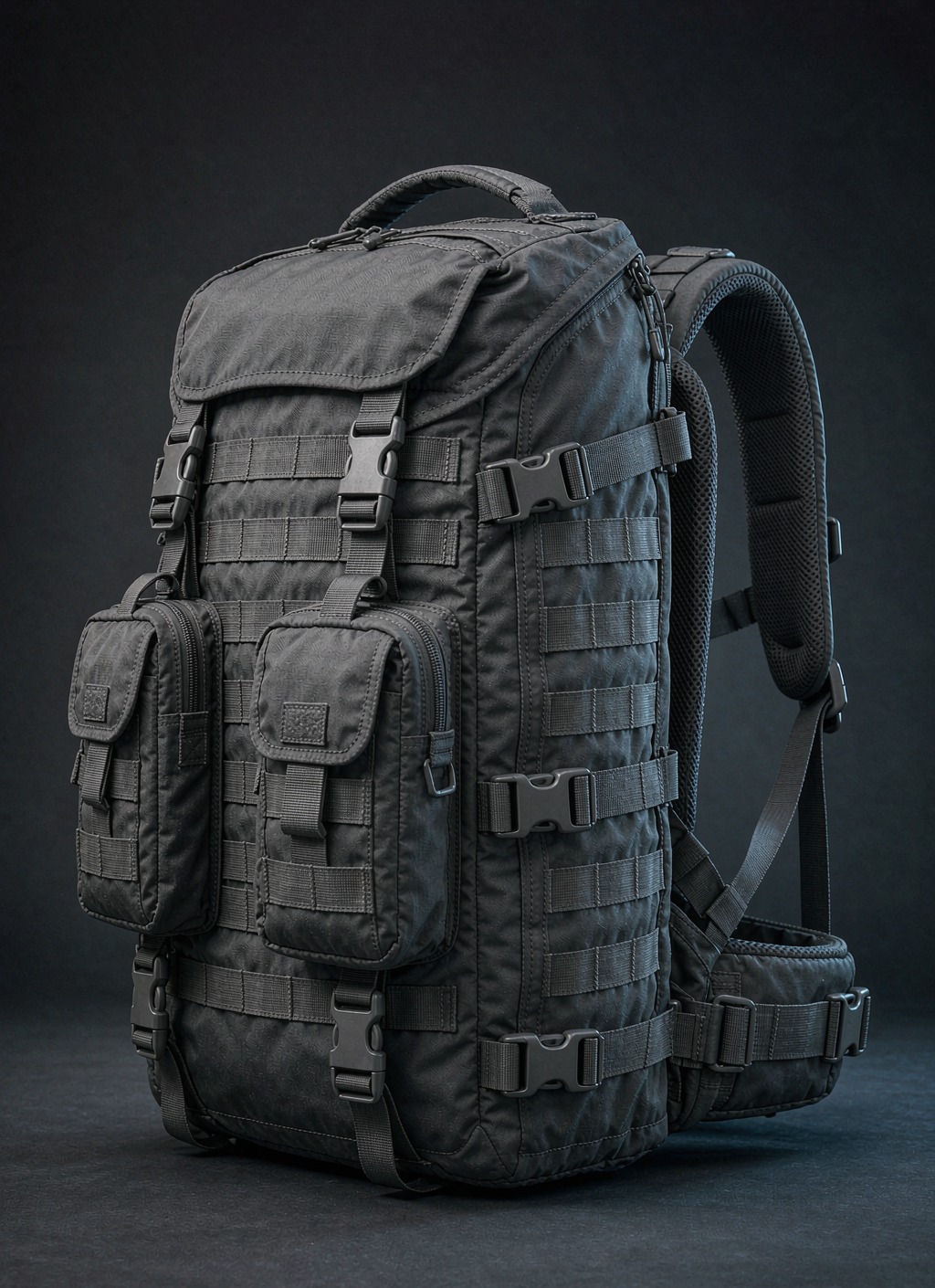
Hook-and-loop module mounting fixes a detachable unit to its chassis with a touch fastener, a hook strip pressing into a loop field so that hundreds of tiny engagements hold the unit in place. Whether that joint survives depends on three numbers the drawings usually omit: the load at which it slides across itself, the much lower load at which one edge lifts and peels away, and the count of press-and-separate events it can take before retention falls below the figure the product needs. Because those figures are an order of magnitude apart, no single strength value describes this fixing method honestly. Prototypes take 6-10 working days, volume occupies 35-50 days, each reference opens at 500 units, and release follows ISO 2859-1 at a 2.5 acceptance quality limit. The application described here is civilian - tools, kits, organisers and medical carry - with no armed or ballistic use implied anywhere in the discussion.
How engagement actually generates holding force
A touch fastener works by multiplication, not by grip. One hook engaging one loop contributes almost nothing; thousands of them acting together produce useful resistance. Holding therefore scales with contact area first and with hook quality second, which is why the same tape behaves very differently on a wide flat panel than on a narrow strip.
Engagement depth decides everything else. When hooks and loops are pressed together firmly, hooks reach past the surface of the pile and catch underneath it. Pressed together lightly, many hooks sit on top of the loops and contribute nothing. Users who press a unit down casually and then wonder why it fell off are usually describing this mechanism rather than a defective tape.
The hook components themselves deform gradually. Nylon hooks are extruded monofilaments bent into a crook shape, and repeated engagement straightens them a little each time. Nothing visibly breaks; retention simply falls cycle after cycle, which is why this fixing method needs a written end-of-life criterion rather than a binary pass or fail.
The loop side has a slower but less forgiving failure. Pile loops stretch, mat down and eventually break away from their backing, leaving a smooth area where nothing engages. Once a loop field becomes glossy in patches - a condition every workshop has seen - that portion of the field has stopped contributing and effective holding area has quietly fallen.
Geometry sets therefore follow from area rather than from aesthetics. Where a unit must resist peeling, the answer is rarely a bigger rectangle: extend the fastener field toward the corners rather than adding a row of stitching through the middle of it.
Spec rule: State the minimum engaged contact area in square centimetres rather than relying on a tape width, because holding comes from the bonded area alone and every square centimetre lost to piping, labelling or curvature removes real capacity.
Shear, peel and direct tension give three different answers
Load arrives three ways at this joint, and quoting one strength figure for all three is the single most common specification error in this category.
| Load orientation | What the hooks do | Relative retention | Method normally cited |
|---|---|---|---|
| Shear across the face | Hooks bear against loop bases together | Highest | ASTM D5169 |
| Direct pull away from the face | Engagements share the load evenly | Moderate | Tension rig, stated rate |
| Peel from one edge | One row at a time releases | Lowest, by roughly an order of magnitude | ASTM D5170 |
| Twisting peel | Progressively unzips from one corner | Lowest of all | Often untested |
The ASTM family includes dedicated methods for the first and third cases - shear under ASTM D5169 and peel under ASTM D5170 - and quoting results from the correct orientation is what separates an engineering conversation from a marketing one.
Shear happens when the unit's contents want to slide downward in the direction it was mounted. Because every engaged hook resists simultaneously, this is the orientation the joint is best at, and most well-mounted units loaded in shear perform adequately.
Peel is the dangerous one and it arrives from directions designers rarely consider: the corner of a unit catching a car door frame, a strap being pulled upward at an angle, contents pushing against one end of the unit so it rocks. Each of these separates one row of engagements at a time, and the resistance each row offers is tiny compared with what the whole field offers together.
Twisting peel, which starts at a corner and progresses diagonally, is the most common real-world variant and the least frequently tested. Any product destined for vehicle work, crowded doorways or dense vegetation should have it checked deliberately rather than assumed covered by a flat peel result.
Verdict: Publish three separate acceptance figures - sliding resistance, straight pull-off and edge peel - and treat the lowest of them as the carrying limit of the assembly, because users will find whichever orientation nobody tested.
Cycle life: retention does not stop, it fades
Durability here is a decay curve rather than a cliff. Each press-and-separate event straightens some hooks and mats some loops, so holding falls gradually from day one. Nothing looks damaged, which is precisely why the failure surprises people.
Rate of decay depends far more on how the joint is used than on whose tape is bought. Separating by peeling gently back from one edge removes hooks slowly; ripping the unit straight off by main force removes them fast. Two users with the same unit can see service lives differing by a large multiple, which is worth putting in the care card rather than in the specification.
Touch-fastener tapes are commonly published with engagement figures running into several thousand cycles, and that number is a laboratory result under controlled pressing and clean conditions. Real programmes should set their own acceptance at a lower, more conservative figure, verified on the actual combination of hook tape and loop field being used rather than borrowed from a supplier datasheet.
Monitoring is straightforward and cheap. Retain an unused reference joint at the start of a run, then compare an aged one against it with a simple pull gauge at intervals through the product's declared life. Where retention has dropped below perhaps sixty or seventy per cent of the original figure, plan for replacement rather than waiting for something to fall off.
Protected engagement slows everything down. A flap that covers the hook tape when the unit is detached keeps contamination out and reduces accidental separation events, and it is the single cheapest way to extend working life in dirty environments.
Takeaway: Write a cycle figure and a retention percentage into the specification rather than a vague durability claim, then verify on retained references pulled at intervals because nobody can predict field behaviour from laboratory engagement counts alone.
Contamination, cleaning and the environments that end it
Lint is the enemy, and it attacks the hook side. Dust, clothing fibres, sawdust, pet hair and paper shreds work into the hook field, gradually filling the gaps between hooks so they cannot reach the loops underneath. Engagement depth falls, and with it holding force. Nothing appears broken - the tape still looks like tape.
| Contaminant | Effect on engagement | Effective remedy | Remedy that damages tape |
|---|---|---|---|
| Loose lint and fibre | Fills gaps between hooks | Stiff brush, then fine comb | Compressed air, which drives it deeper |
| Dried mud or soil | Cements hooks together | Soak, then brush under water | Stiff wire brush |
| Oil and grease | Attracts and binds grit | Warm water with mild detergent | Solvent cleaners |
| Resin or sap | Coats hook tips | Freezing then flexing | Heat above 60 C |
| Paint overspray | Permanently bridges hooks | None reliable | Solvent stripping |
Where to avoid it matters as much as how to clean it. Workshops generating airborne fibre, willowing textile environments, vehicles with fabric interiors and any setting with loose animal hair will degrade this fixing method faster than its specification suggests. In such settings a webbing-and-strap route with a small touch-fastener patch for stability often outperforms a full field.
Cleaning method matters because most attempts remove engagement along with the dirt. Pulling the joint apart dry and dragging debris across the hook face damages hooks; compressed air pushes contamination deeper; hot water or solvents deform nylon components permanently; an aggressive wire brush straightens hook tips and guarantees nothing will engage again.
Thread path deserves its own mention. Stitching through the middle of a hook field divides it into two smaller fields, and those wasted square centimetres are permanently unavailable no matter how well the tape is cleaned.
Bottom line: Specify a cleaning card, keep any stitching out of the middle of the working area, and where the duty environment generates airborne fibre, either cover the hook face when the unit is detached or choose a mechanical fixing instead.
Mounting routes compared for retention, silence and contamination tolerance
Four routes compete here, and the honest comparison is not about which is strongest but about which fails acceptably. Chosen well, every one of them supports civilian loads; chosen badly, each fails in its own characteristic way.
| Route | Retention under loaded use | Acoustics during access | Behaviour when dirty | Recurring cost |
|---|---|---|---|---|
| Full touch-fastener field | Good in shear, poor at edges | Loud tearing, unsuitable for quiet settings | Degrades steadily unless cleaned | Lowest |
| Webbing channels with a strap | Strong in all three orientations | Silent | Unaffected | Moderate |
| Snap post or press-stud, mechanical | Moderate, positive engagement | Quiet click | Unaffected | Moderate plus tooling |
| Fastener field plus a mechanical safety | Strong; either element alone holds | Quiet until separated | Falls back to the mechanical element | Highest |
The paired route deserves particular attention. A field does the alignment and anti-rattle work while a small strap, press-stud or post takes the peeling load, so each element covers the other's weakness. What looks like belt-and-braces engineering often costs less than expected because both elements can be smaller than either would need to be alone.
Silence deserves more attention than fashion budgets allow. Removing a unit from a touch-fastener field makes a tearing sound that carries across a room, which is why hospitality, healthcare and office users complain about it. Where the brand targets those settings, specification should favour the mechanical routes even if they cost marginally more.
Garment damage is the related worry. Hook components abrade knitwear and brushed synthetics, and colour transfer onto pale clothing is checked to AATCC 8 before any claim of garment safety belongs in copy. Where contact with formal clothing is expected, locating hook tape low and inward, rather than high on the front panel, is the cheapest mitigation available.
Judgement: Choose a full field only where the load stays light, a low exterior profile dominates and quietness does not matter; choose the paired field-plus-mechanical arrangement wherever the unit is heavy, carried daily or expected to last several seasons.
Testing plan and the defects that escape it
A test plan for this joint needs five checks, and three of them are routinely skipped because they take people rather than equipment.
First, sliding resistance after pressing the joint with a stated force applied over a stated area - reproducing how a user actually closes it rather than how laboratory operators do. Second, straight pull-off at a stated rate. Third, peel from one edge, which is where the design usually loses. Fourth, retained function after cyclic separation, comparing against the unused reference. Fifth, behaviour after contamination with a defined loading of lint or dust, because that is the condition the product actually lives in.
Material checks sit alongside. The shell fabric carrying the loop field has to resist the repeated abrasion of hooks dragging across it, which is assessed with either ASTM D3884 or the cyclic flat method set out in ISO 12947, both run on the finished laminate rather than the base cloth.
Assembly defects cluster predictably. Hook and loop fields mis-registered by several millimetres look fine and hold badly; stitch lines passing through the middle of a field permanently remove working area; and units sewn with the two components partly overlapping leave a hard lump that prevents full engagement and rocks in service.
Inspection for those three is cheap and belongs in-line rather than at release, because all three are instantly visible once somebody knows to look. Allow six to ten working days for a conventional sewn combination, twelve to fifteen where the joint is welded rather than sewn or where the loop pile is a new laminate.
Selection rule: Require four rated results plus condition sweep before approving any touch-fastener joint, since a joint that passes straight pull-off alone will still fail in the field through edge peeling or contamination.
Sourcing, sampling and the floor behind the decision
Tape selection is a supply decision before it is a design decision. Nylon-derivative hook tape and its mating loop pile come from several tiers of supplier with visibly different hook geometry, and mixing one supplier's hooks with another's loops - common when an early approval used samples from different sources - produces unpredictable retention that no amount of later adjustment fixes.
Vetted partner facilities provide the assembly environment this work needs, coordinating a verified 4,950 m² base carrying 7 production lines and 149 machines operated by a workforce of 137 people at roughly 200,000 pieces monthly; the founder's involvement with bag production runs back to 2004 and the organisation dates from 2014. Approvals arrive 6-10 working days after the pattern is confirmed, with 12-15 working days where a bonded or welded joint enters construction.
Volume then runs 35-50 days, and the upper figure applies wherever bought-in hardware - custom-shaped hook strips, injection components, proprietary press-stud families - carries an independent lead time. Every reference begins at 500 units, including each additional unit added to an existing roster.
Commercial terms are unremarkable: indicative figures quoted FOB Xiamen with T/T 30/70 settlement, replies normally inside 24-48 hours, a development fee of USD 50-150 credited back when bulk is placed, and tooling or dies between USD 300-2,500. Then comes transit - 25-35 days over water, 5-8 days flown, 3-5 days by express - after which volume matters, since 20GP holds about 28 CBM and 40HQ about 68 CBM.
Spec rule: Lock hook and loop components from one supplier as a matched pair in the specification, and require re-approval rather than substitution if either half changes source, because cross-brand combinations cannot be qualified from datasheets.
Where the touch fastener earns its place on a range
The honest summary is that this fixing method solves a specific problem extremely well and is asked to solve several others it is poor at. Its strength is providing continuous position freedom over an area, letting a unit sit anywhere on a receptive field rather than at fixed intervals. Nothing else in this price class does that, and no amount of mechanical engineering will.
It is therefore the right answer for flat light units that people want to reposition - identification panels, thin organisers, small first-aid inserts, cable management pieces, flat tool slips - and the wrong answer for anything dense that swings as the wearer walks.
The combination approach resolves most civilian programmes better than either extreme does. A modest touch-fastener area stabilises position and silences rattle, while one mechanical element - a strap through tape channels, a press-stud pair, or a small post and socket - carries the peeling load. Neither element needs to be large, since each covers the other's weakness rather than duplicating its strength.
Programmes that cannot accept the acoustic behaviour should not specify it at all, and programmes operating in fibre-heavy environments should plan cleaning intervals rather than pretending the problem does not exist.
Designers choosing between routes can compare against our standard lattice geometry and its tolerance notes, check how it behaves alongside the mechanical families listed under chest and waist carry platforms, and, for tool-heavy work where dirt is unavoidable, read the duty-profile notes for work chassis carrying trades equipment. Where a range is expected to carry heavy tools, our fuller comparison of joining technologies sits in the article on modular connection systems and their trade-offs, which complements what is set out here.
One line settles it for most ranges: use the field for position, use mechanics for load, and never ask one to do the other's job.
Frequently asked questions
What is hook-and-loop module mounting used for on a civilian chassis?
It holds flat relatively light units against a receptive field, letting the wearer reposition them freely. It suits identification panels, thin organisers, first-aid slips and cable management pieces rather than dense items that swing while walking.
- Light flat loads
- Variable position
- Low exterior profile
Why does the same tape hold well sometimes and fail completely at others?
Because the three load orientations differ enormously. Sliding across the face engages every hook together, pulling straight off is weaker still, and lifting one corner separates one row at a time and can be roughly ten times weaker than the shear case.
How strong is a touch-fastener joint compared with tape channels and a strap?
Comparable in pure shear, far weaker against peeling. Tape channels distribute load through bar-tack anchoring into the chassis, whereas a field relies on thousands of small engagements that release progressively from whichever edge is lifted first.
What test methods apply when approving a hook-and-loop fixing?
Shear under ASTM D5169 and edge peel under ASTM D5170 cover the two behaviours that matter most, with straight pull-off measured separately. Add abrasion checks with ASTM D3884 or ISO 12947 on the finished laminate carrying the loop pile.
How many open-and-close cycles should a programme accept for?
Supplier datasheets quote figures in the thousands under clean conditions, which real duty rarely matches. Set your own acceptance lower and verify against a retained unused reference pulled at intervals through the declared service life.
What percentage loss should trigger replacement rather than continued use?
Plan replacement of components once retention drops to roughly sixty or seventy per cent of the unused reference, remembering the decay is gradual and invisible. Nothing looks broken while holding quietly halves.
How should a lint-filled hook field be cleaned?
Brush with a stiff bristle brush and pick remaining debris out with a fine comb. Avoid compressed air, which drives particles deeper, and avoid solvents or wire brushes, which deform hooks permanently.
Does specifying a larger rectangle always improve holding?
Yes, provided every centimetre genuinely engages. Stitching through the middle of a field divides it into two smaller working zones, permanently removing that area, so reposition seams rather than widening the tape around them.
Why is the fixing unpopular in offices and healthcare settings?
The tearing sound made on separation carries across quiet rooms. Where silence matters, mechanical alternatives costing marginally more are normally preferred, even though those routes cost slightly more per unit.
Can hook tape damage clothing worn under the bag?
Yes, particularly knitwear and brushed synthetics. Colour transfer is assessed under AATCC 8, and the cheapest mitigation is locating hook tape low and inward rather than high on a front panel that rubs against garments.
When is combining a field with a mechanical fixing worthwhile?
Whenever the unit is heavy, carried daily or expected to last several seasons. The fastener stabilises position and silences rattle while a strap, press-stud or post takes peeling load, so each element can be smaller than it would be alone.
Can hook and loop components be mixed between suppliers safely?
No. Cross-brand combinations of hooks and loops give unpredictable retention that datasheets cannot qualify. Lock both halves from one source as a matched pair and require re-approval if either changes.
How long does sampling take for a bonded fastener joint?
Six to ten working days covers a conventionally sewn combination, rising to twelve to fifteen where the joint is welded or the loop field uses a new laminate. Volume then runs 35-50 days depending on bought-in hardware lead times.
What does a first approval order cost beyond unit pricing?
A USD 50-150 development fee credited back once bulk is placed, plus USD 300-2,500 for tooling or dies. Each reference opens at 500 units and figures are indicative, quoted FOB Xiamen with T/T 30/70 settlement.