Home › Field notes › What Is Hydrostatic Head in Waterproof Fabric? Test Scope and IPX Limi
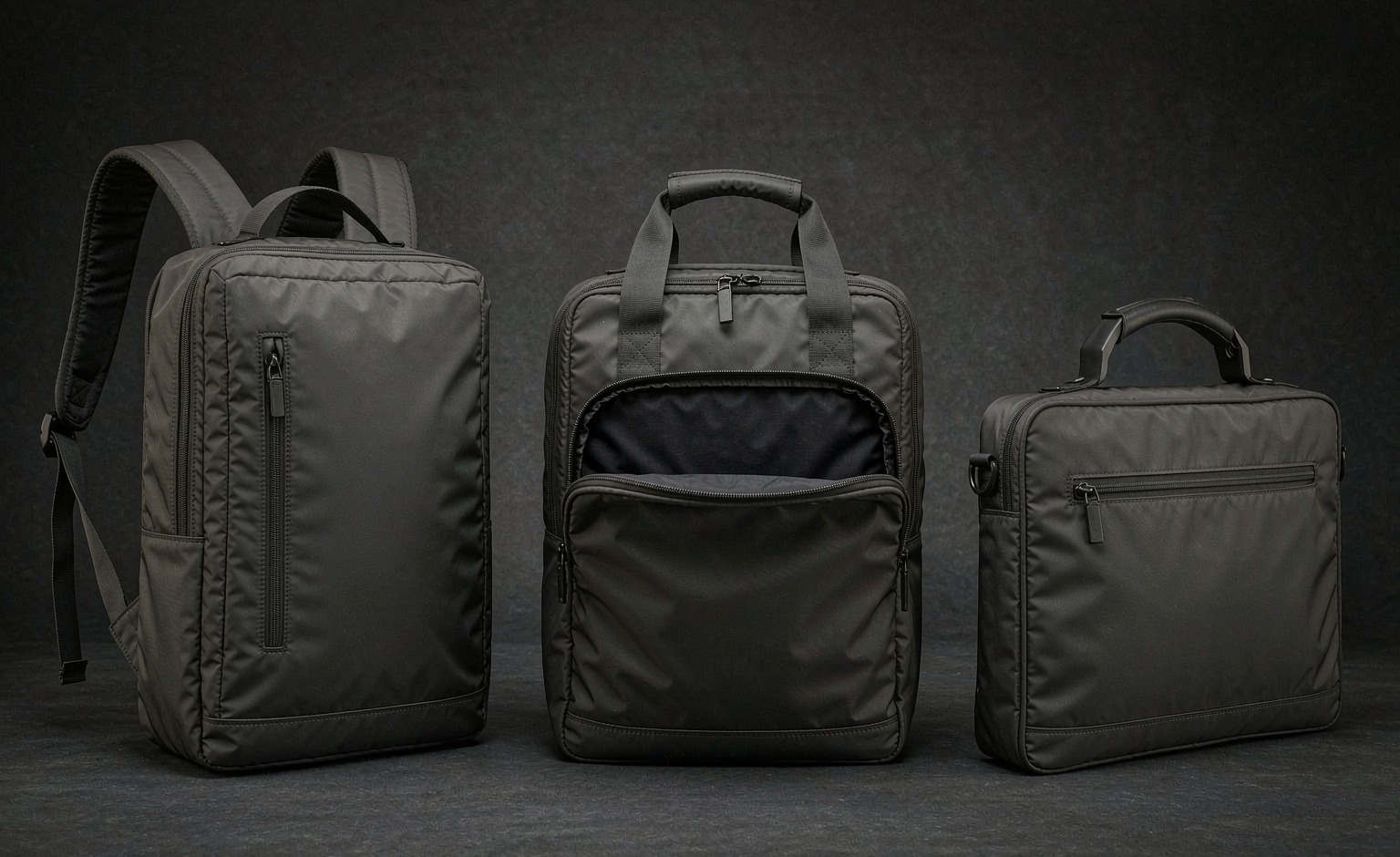
Hydrostatic head is the height of a water column, expressed in millimetres, that a fabric withstands before water penetrates through it under a defined laboratory procedure. It measures one thing: resistance of flat, unused, unsupported cloth to penetration under steadily rising pressure, tested on the material and never on the bag. A rating on a finished article under IEC 60529 is a separate assessment of a complete assembly with seams, closures and hardware in place, and no fabric value converts into it. Buyers who treat a shell figure as a product rating meet the difference in the first heavy shower. Development opens at 500 pieces per reference, samples take 6-10 working days, and confirmed volume runs 35-50 days. Scope covers outdoor, worksite and commute use for tool kits, instruments, first-aid contents and consumer electronics, and excludes firearms, munitions, armour and defence-standard declarations.
What hydrostatic head measures, stated precisely
The test clamps a specimen of flat fabric over an opening and exposes one face to a column of water. The column is raised, or the pressure beneath it increased, until water appears on the far face. The height of the column at that moment is the result, reported in millimetres of water column. A higher figure means the cloth resisted penetration under greater pressure.
Three qualifiers are built into that sentence and each one limits what the number can be used for. The specimen is flat, so it is not stretched over a corner, folded around a seam or compressed under a strap. It is unused, so it has not been abraded, laundered, flexed or exposed to sunlight. It is unsupported in the sense that nothing presses on the far side and nothing concentrates load onto the wet face.
None of those conditions holds in service. A bag in rain has fabric tensioned across a frame, folded at seams, abraded where it meets clothing, and pressed against a wearer's back by strap tension. Every one of those conditions lowers real-world resistance relative to the laboratory figure, which is why the number is best understood as a ranking tool for comparing materials rather than as a prediction of field behaviour.
Used correctly, it is a genuinely useful ranking tool. Two candidate shells measured by the same procedure can be ordered reliably, and a buyer can confirm that a substituted fabric is not inferior. Used incorrectly, as a promise about a finished product, it produces disputes that no amount of testing on flat cloth can settle.
Selection rule: Use hydrostatic head to rank candidate fabrics measured by the same procedure, and never present it as a performance promise about a sewn, closed and assembled product.
How the test is run: apparatus, rate of rise and endpoint
The apparatus is simple in principle. A specimen is clamped horizontally, water is admitted to one face through a rising column or a regulated pressure source, and an operator watches the far face for the first sign of penetration. What varies between laboratories is the rate at which pressure rises, the area of cloth under test, the definition of the endpoint, and the conditioning of the specimen before it is mounted.
Rate of rise matters more than most specification sheets acknowledge. A fast ramp gives the water less time to find a path through the weave or coating, and therefore tends to produce a higher figure than a slow ramp on identical cloth. Any comparison between two quotations is meaningless unless both used the same rate, which is why the procedure name belongs next to the number.
The endpoint is defined differently in different procedures: some wait for the first drop to appear, others for a specified number of drops, and some for a visible change across a defined area. The differences are small in laboratory terms and can be large in commercial terms when a buyer has written a threshold into a contract.
Conditioning is the remaining variable. A specimen tested dry and new behaves differently from one that has been wet out, dried and retested, and differently again after abrasion or laundering. Specifying the conditioning state alongside the procedure is what turns a figure into a defensible requirement.
The procedure most often cited for this property in apparel and equipment textiles is AATCC 127, and naming it, together with the rate of rise and the endpoint definition, is the single most effective step a buyer can take to make two supplier claims comparable.
Verdict: Require the procedure name, the rate of pressure rise, the endpoint definition and the conditioning state to appear with every hydrostatic head figure, because a bare number cannot be compared across two laboratories.
Reading the number: what a millimetre figure does and does not purchase
A millimetre of water column is a pressure unit, so the figure tells a buyer how much pressure the cloth held before penetration. What it does not tell a buyer is how long the cloth would hold under sustained load, how it behaves when abraded, or how it performs once needle holes have been punched through it at every seam.
The sustained-load question is the one that surprises people. A laboratory ramp takes minutes. A strap pressing a wet panel against a back for an hour applies far lower pressure for far longer, and time-dependent penetration through a coating or a laminate bond is not captured by a ramp test at all.
The abrasion question follows the same pattern. A pack rubbing against a work jacket for a season loses surface finish and, with it, much of the resistance that produced the original figure. Ratings measured on new cloth and quoted without an abrasion-conditioned value are initial values, not maintained values, and the specification should say so.
The perforation question is the most important for sewn goods and is addressed in the next section. Every seam needle hole is a potential path, and a fabric that resists penetration perfectly through its coating can leak freely along a stitch line where that coating has been punctured hundreds of times.
Bottom line: Treat the millimetre figure as an initial value on new, flat, unabraded cloth, and write separate requirements for abrasion-conditioned performance and for seam leakage if those matter to the product.
Why a fabric value can never become a finished-product IPX rating
This is the point that causes most commercial disputes, and it rests on a simple distinction: one test assesses a material, the other assesses an enclosure. A fabric test clamps a flat specimen and asks whether water crosses it. An enclosure test takes a complete assembled article - every seam sewn, every closure fitted, every hardware pass-through installed - and subjects the whole object to a defined water exposure, then inspects the interior for ingress.
Because the enclosure test is made on the object, its result is governed by the weakest path into that object, and the fabric is almost never that path. Stitch lines, zipper tapes, binding folds, hardware holes and lid geometry all offer routes that bypass the shell cloth entirely. A bag built from a shell with an outstanding material figure can fail an enclosure test badly, and a bag built from more modest cloth can pass it, purely because of how the seams and closures were executed.
The direction of the logic matters too. A high material figure does not imply a high enclosure result, and a low material figure does not forbid one. There is no conversion table, no multiplier and no rule of thumb, because the two tests measure different objects under different conditions. Any supplier document that implies a conversion is describing a marketing position rather than a measurement.
The correct purchasing sequence is therefore to specify both separately. Ask for the fabric figure with its procedure named, as a material requirement. Ask separately for the enclosure rating established by testing the finished article, if a rating is genuinely needed for the product claim. Then check that the product documentation states each in its own terms and never blends them.
Enclosure testing for ingress protection is published as IEC 60529, and its codes describe degrees of protection against solid objects and water for enclosures, assessed on the assembled article. It is the correct reference when a finished-product claim is being made, and it is not interchangeable with any fabric measurement.
Takeaway: Specify the fabric figure and the finished-article rating as two independent line items with two independent test reports, and refuse any document that converts one into the other.
Where finished goods actually let water in
Leak paths in a sewn product follow a consistent ranking, and the shell cloth sits near the bottom of it. Understanding the ranking directs specification effort to where it produces results.
| Leak path | Mechanism | Fabric figure relevance | Control that works | How verified |
|---|---|---|---|---|
| Sewn seam stitch line | Water tracking along needle holes through the coating | Almost none; coating is punctured | Seam sealing tape or welded construction | Seam leakage test on a sewn specimen |
| Zipper or closure | Water crossing the tape and the element line | None; the closure is a separate component | Storm flap, coated zipper, drainage path | Finished-article exposure test |
| Hardware pass-through | Water entering at grommets, ports and strap slots | None; the hole bypasses the cloth | Backed plate, gasket, or relocated fixing | Finished-article exposure test |
| Abrasion zone | Surface finish worn away, coating thinned | High initially, decays with wear | Abrasion-conditioned requirement, tougher face | Abrasion then retest |
| Shell fabric panel | Penetration through intact cloth under pressure | Directly relevant | Higher rated cloth, coating or laminate | AATCC 127 on the flat specimen |
Reading the table top to bottom is instructive: the four paths above the fabric are the ones that actually admit water in returned products, and the fabric panel itself is the path least often responsible. That is why a large material figure, quoted proudly and tested correctly, still does not predict whether a bag keeps contents dry.
It also explains a common commercial pattern. Two suppliers quote identical cloth. One builds sealed seams with a storm flap over the closure and the other does not, and the finished products differ enormously in real weather despite sharing a material figure.
Judgement: Budget specification effort towards seams, closures and pass-throughs before chasing a higher fabric figure, because the shell panel is rarely the path water takes.
How the figure changes with wear, laundering and flexing
Three service conditions degrade the measured value, and each needs its own requirement if a product is sold on water resistance.
Abrasion removes surface finish and thins the coating. Testing cloth after a defined abrasion procedure, then remeasuring, gives a retained value that is far more informative than the initial one. A buyer comparing two shells should compare retained values rather than initial ones, because initial values often rank differently from retained values.
Laundering and wet-dry cycling attack laminate bonds. Adhesive layers take up water, plasticise, and lose bond strength over repeated cycles, so a laminate that performs well new can delaminate after a season of use. The failure appears as bubbling near a seam or as a silvery lift line, and it removes shear transfer rather than cloth strength.
Flexing concentrates damage at folds. A panel that is folded repeatedly in the same place develops a crease where the coating cracks, and that crease becomes a penetration path at pressures well below the original figure. Products with lids that roll, or with panels that fold for storage, need a flex-conditioned requirement.
Standard textile practice supports all three: abrasion resistance is referenced to ISO 12947, domestic washing procedures to ISO 6330, and colour transfer to AATCC 8 where a printed face is involved. Conditioning the specimen before the penetration test is what makes the resulting figure meaningful for service.
Require a retained value measured after defined abrasion, laundering and flex conditioning, and state in the document that the initial figure is an initial value rather than a maintained one.
Hydrostatic head compared with spray, shower and immersion procedures
Four families of water test appear in specifications, and they answer four different questions. Confusing them is the most common source of mismatched expectations between a buyer and a supplier.
| Test family | What it measures | Specimen | Claim it supports | What it cannot show |
|---|---|---|---|---|
| Hydrostatic penetration | Pressure at which water crosses the cloth | Flat fabric swatch | Material ranking and material specification | Anything about seams, closures or shape |
| Spray rating | Surface wetting and runoff under a light spray | Flat fabric swatch, mounted at an angle | Surface finish and beading behaviour | Resistance under sustained pressure |
| Shower exposure | Water striking an assembled item from above | Complete article, sometimes with contents | Behaviour in rain on that specific design | A transferable rating for other designs |
| Enclosure immersion | Ingress into a sealed enclosure under defined conditions | Complete assembled article | A stated degree of protection against water | Material performance or durability over time |
The distinction that matters commercially is the specimen column. Two of the four are made on swatches and tell a buyer about material. Two are made on objects and tell a buyer about a design. A material result cannot be promoted into a design claim, and a design result does not transfer to a different design even when the cloth is identical.
Where a product genuinely needs a stated degree of protection against water, the enclosure family is the only defensible basis for that statement, and it has to be established on the article that will be sold. Where a product only needs to shed a shower, a shower exposure on the finished item plus a material figure for the cloth is a more honest and more useful pair of requirements.
Writing water resistance requirements a supplier can be held to
Four lines convert the discussion above into enforceable purchasing language, and each one closes a specific loophole that appears regularly in supplier documentation.
- Material line: the fabric figure, with the procedure named, the rate of rise stated and the conditioning defined.
- Retention line: the figure measured again after defined abrasion and laundering cycles, expressed as a retained value.
- Seam line: whether seams are sealed or welded, and the leakage result for a sewn specimen rather than a swatch.
- Article line: whether a finished-article rating is claimed at all, and if so the code established by testing the assembled product.
Wording matters as much as content. A document that says the fabric is "waterproof to 5,000 mm" invites the reader to assume the bag is waterproof, which is precisely the inference the preceding sections show to be unfounded. A document that says the shell cloth resists penetration to a stated figure under a named procedure, and separately whether the assembled article carries a tested rating, states two facts and invites no false inference.
Buyers should also require the test report rather than the claim. A report identifies the laboratory, the procedure, the specimen and the conditioning, and it can be re-commissioned on a production sample. A claim on a specification sheet can be reworded at will.
Programmes building a hiking-oriented modular shell usually need all four lines, because sustained shoulder-strap pressure, abrasion against clothing and repeated wet-dry cycling all appear in that duty profile. The same structure suits travel-oriented modular formats, where lid geometry and closure choice dominate, and current shell options sit on the modular product range.
Spec rule: Separate the material line, the retention line, the seam line and the article line into four numbered requirements, and require a laboratory report for each rather than a summary claim.
Programme mechanics, capacity and scope limits
The programme sits with QUANZHOU JUNYUAN BAGS, established in 2014, whose founder entered bag production in 2004. Its SGS-verified floor spans 4,950 m², 137 people, 149 machines, 7 lines, and monthly capacity close to 200,000 units. The sequence - specification, sample, approval, bulk, inspection, shipment - is fixed, and material approval happens before sampling rather than during it.
On quantities: one reference starts at 500 pieces. Sampling needs 6-10 working days, or 12-15 when a welded seam or new coating is involved, and the confirmed run then occupies 35-50 days.
On money: sampling costs USD 50-150, deductible from the production invoice, and plates or screens add USD 300-2,500 where branding is new. Price guidance is FOB Xiamen, settlement T/T 30/70, and enquiries are answered in 24-48 hours.
On logistics: by sea allow 25-35 days, by air allow 5-8 days, by courier allow 3-5 days. A 20GP takes roughly 28 CBM; a 40HQ about 68 CBM. Goods are cleared at AQL 2.5, applying ISO 2859-1 at level II, and water-related checks - seam sealing continuity, closure function, coating appearance - are added to the standard inspection so the material decision is verified on the finished item.
Scope limits remain. Nothing above predicts ultraviolet ageing of a coating or hydrolysis of a laminate bond in humid storage, and both are material-ageing questions requiring their own programme. Chemical compliance is separate again: coatings, dyes and finishes fall under REACH (EC 1907/2006) and under Prop 65 obligations for the destination market.
The scope is also civilian. Water resistance is discussed for tool kits, instruments, first-aid contents, hydration and consumer electronics in outdoor, worksite and commute use. Firearms, munitions, armour and defence-standard declarations are outside it, and no claim of conformity to a military specification is made for any material or construction discussed here.
Frequently asked questions
What is hydrostatic head in waterproof fabric?
The height of a water column, in millimetres, that a fabric withstands before water penetrates it under a defined laboratory procedure. It ranks materials under rising pressure. Programmes open at 500 pieces with samples in 6-10 working days and volume across 35-50 days.
Which procedure should be named with a hydrostatic head figure?
AATCC 127 is the procedure most often cited for penetration resistance in equipment textiles. Name it alongside the rate of pressure rise, the endpoint definition and the conditioning state, or two supplier numbers cannot be compared.
- Procedure
- Rate of rise
- Endpoint
- Conditioning
Why does a fabric hydrostatic head figure not equal a finished product IPX rating?
One test assesses flat cloth, the other assesses a complete assembled enclosure with seams, closures and hardware. IEC 60529 degrees of protection are established on the whole article, and no fabric value converts into that result.
Can a bag with a high fabric figure still leak badly?
Yes. Water usually enters through stitch lines, zipper tapes, hardware pass-throughs and lid geometry, all of which bypass the shell cloth. Those paths govern the result far more often than penetration through an intact panel.
What is the most common leak path in a sewn bag?
The seam stitch line, because every needle hole punctures the coating and gives water a path along the thread. Seam sealing tape or welded construction is the control, verified on a sewn specimen rather than on a flat swatch.
Does the fabric figure fall after abrasion and washing?
It does. Abrasion removes surface finish, laundering attacks laminate bonds and flexing cracks coatings at folds. Specify a retained value measured after conditioning rather than relying on the initial figure.
How does rate of pressure rise change the result?
A fast ramp gives water less time to find a path, so it tends to produce a higher figure than a slow ramp on identical cloth. Comparing two quotations is meaningless unless both used the same rate.
What is the difference between a spray test and hydrostatic head?
Spray assesses surface wetting and runoff under a light spray on a mounted swatch; hydrostatic head assesses penetration under rising pressure. One describes finish behaviour, the other describes resistance to pressure.
When should a finished article be tested instead of the fabric?
Whenever a claim is made about the product rather than the material. Enclosure exposure is assessed on the assembled article, because seams, closures and hardware decide the outcome and swatch data says nothing about them.
Which conditioning standards support a water resistance requirement?
Abrasion resistance is referenced to ISO 12947, domestic washing to ISO 6330, colour transfer to AATCC 8, and penetration to AATCC 127. Conditioning the specimen before testing is what makes the figure meaningful in service.
How should water resistance be worded in a specification?
State the shell figure with its procedure as a material line, then state separately whether the assembled article carries a tested rating. Never write a fabric figure in a way that lets a reader infer a product claim.
How long does sampling take when welded seams are involved?
Six to ten working days covers standard construction; twelve to fifteen where welded seams or a new coating appear. Production then occupies 35-50 days, driven by bought-in component lead times.
What does a first water resistant reference cost beyond unit price?
Sampling is billed at USD 50-150 and deducted from the production invoice; plates or screens add USD 300-2,500. Minimum quantity is 500 pieces, with indicative pricing FOB Xiamen, T/T 30/70 payment and a reply within 24-48 hours.
Which shipping mode suits a first water resistant programme?
Allow 25-35 days for sea transport of planned inventory, 5-8 days for air against a locked launch date, and 3-5 days for courier approval sets. Container planning: about 28 CBM per 20GP, roughly 68 CBM per 40HQ.
Does water resistance testing cover chemical compliance?
No. Coatings, dyes and finishes fall under REACH (EC 1907/2006) and under Prop 65 obligations for the destination market, and those declarations travel separately from any penetration report.
What scope is excluded from this water resistance discussion?
Firearms, munitions, armour and defence-standard declarations. The remit covers outdoor, worksite and commute protection for tool kits, instruments, first-aid contents, hydration and consumer electronics.