Home › Field notes › Fibre Content Labelling Requirements: What to Declare, How Coatings Co
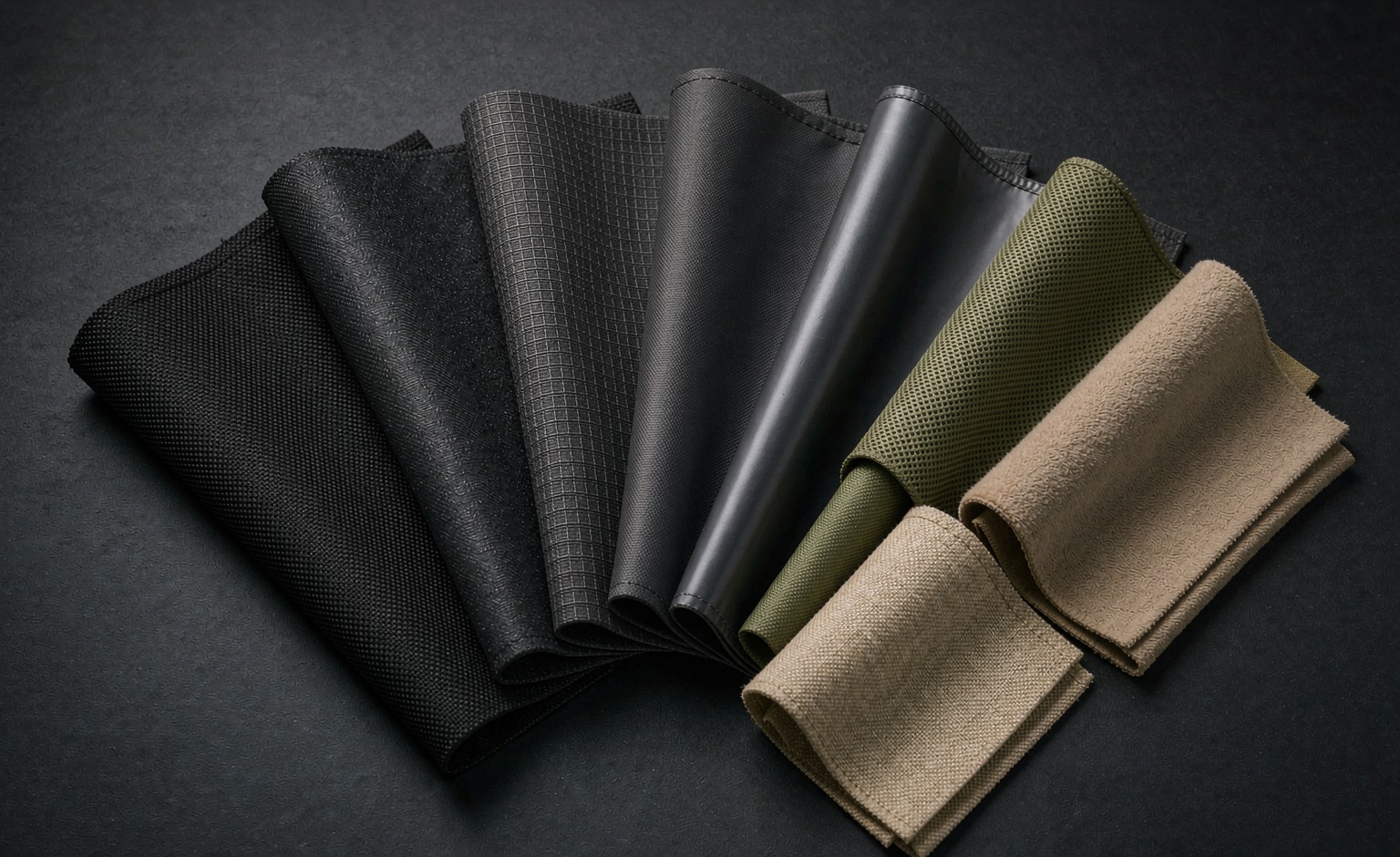
Fibre content labelling requirements are destination-market dependent, and the engineering task behind them is to decide which components enter the declaration, whether a coating or laminate is counted, and which generic fibre names are used. A bag is not one material but an assembly: shell fabric, lining, webbing, foam, thread and hardware each sit differently in a composition statement. The boundary is that thresholds, rounding practice and wording are confirmed with your broker or retailer for each destination; what follows here is the declaration logic, not a statement of any market's rule.
What a Fibre Content Statement Has to Declare
A composition statement answers one question: what is this article made of, and in what proportion. On a garment the question is easy because a garment is usually one cloth. On a bag it is not, because a bag is an assembly of a shell fabric, a lining, a webbing system, a foam or frame sheet, a thread set, a coating or laminate, and a set of hardware parts in metal or plastic. Each of those sits differently in a declaration, and the first engineering job is to decide which of them the statement is actually about.
Three scoping decisions follow. First, is the statement about the whole article or about the visible outer surface? Second, do non-textile parts — hardware, foam, frames — appear at all, and if so how? Third, is the percentage basis weight or surface area? Those three answers differ between markets and between product types, and they are exactly the questions that must be put to the broker rather than assumed. What can be done in advance is the component inventory, because that inventory is the same whichever way the market answers.
The inventory is built from the bill of materials, not from the marketing copy. A shell described as "nylon" may be a nylon face with a polyurethane coating and a polyester backing; a lining described as "polyester" may be a polyester knit with a thermoplastic laminate; a strap described as "webbing" is usually a separate item with its own composition and its own supplier. Writing the inventory at component level, with each component's composition recorded as supplied, is what turns a declaration from a guess into a document.
Selection rule: Build the component inventory from the bill of materials before any percentage is written down, record each component's composition exactly as its supplier states it, and put the scoping questions — whole article or surface, non-textiles included, weight or area basis — to the broker in writing.
Coatings, Laminates and Finishes: Counted, Declared Separately, or Not Counted
Coatings are where declarations most often go wrong, because a coating is not a fibre and yet it can be a substantial share of the finished cloth by weight. A polyurethane coating on a lightweight shell, a thermoplastic polyurethane laminate, a durable water-repellent finish and a printed or sprayed backing all sit in the same family of questions: is the treated weight counted, is the treatment named alongside the fibre, or is it ignored.
The engineering answer is that the treatment changes the numbers and therefore has to be decided explicitly. A finished cloth weighed after coating is heavier than the same cloth weighed before, so a percentage calculated on finished weight distributes differently from one calculated on greige weight. Whichever basis the market requires, the specification sheet should record both the base composition and the treatment, because a laboratory report or a retailer's own test will otherwise appear to contradict the label.
| Treatment | Weight share of the finished cloth | Handling in the declaration |
|---|---|---|
| Pigment or print layer | Under about 2 percent | Normally disregarded; the base fibre carries the declaration |
| Durable water-repellent finish | Under about 3 percent | Normally disregarded, though the finish is named in the specification |
| Polyurethane coating on the reverse face | Roughly 10-30 percent on light cloths | Recorded separately from the base fibre; treatment in the statement is a market question |
| TPU laminate film | Can exceed 30 percent on a light shell | Recorded separately; the finished weight basis must be stated on the sheet |
| Foam or spacer laminated to a lining | Varies with foam density | Treated as a separate component rather than as part of the cloth |
The table's third column is deliberately cautious for a reason. Whether a coating must be named in the consumer-facing statement, and on what basis, is destination-market dependent: confirm it with your broker or retailer rather than inferring it from a competitor's label, which may have been produced under a different rule or a different product category. What is safe to state, and what the specification sheet should always state, is the base fibre, the treatment type and the finished weight.
Verification closes the gap between claim and cloth. Where a coating is declared, the coating is characterised for adhesion and strength to ASTM D751 on coated and laminated constructions, and the water resistance of the finished fabric is measured to AATCC 127. Those tests do not decide what the label must say, but they produce the report that supports the specification if a retailer asks what the treatment actually is.
Verdict: Record the base fibre, the treatment type and the finished weight for every treated cloth on the specification sheet, and leave the question of how the treatment appears in the consumer statement to the broker's written answer.
Multi-Material Construction: Which Parts Enter the Declaration
A modular platform is the hardest case for a composition declaration, because the number of distinct materials is higher than in a conventional bag and because the platform is sold with parts that can be detached. The shell and the lining are textiles. The webbing grid is a textile. The foam in the back panel is a polymer, not a fibre in the usual sense. The frame sheet may be aluminium or a thermoplastic. The hardware is metal or engineering plastic. The thread is a textile and is usually ignored by weight.
The practical approach is to assign each component to one of three buckets: declared as a textile, declared as a non-textile part, or excluded as a minor component. The assignment is recorded in the specification sheet and then presented to the broker as a question, because which bucket a given component belongs in is a market determination. What the programme controls is the accuracy of the component list and the honesty of the weight split behind it.
| Component | Bucket in the declaration map | Reason recorded on the sheet |
|---|---|---|
| Shell fabric, coated | Textile; treatment noted separately | Largest single share by weight; drives the headline figure |
| Lining fabric | Textile | Second-largest share; composition often differs from the shell |
| Webbing grid | Textile; separate item | Supplied separately; commonly polyester where the shell is nylon |
| Back panel foam and spacer | Non-textile part | Polymer foam, not a fibre; weight share is significant on a framed pack |
| Frame sheet or stay | Non-textile part | Thermoplastic or aluminium; small weight share, high function |
| Hardware: buckles, sliders, hooks | Non-textile part | Engineering polymer or metal; usually excluded from fibre percentages |
| Thread | Minor component | Low weight share; recorded for completeness rather than declared |
| Detachable module | Declared as its own article | Sells separately in many programmes and carries its own statement |
The last row matters for modular systems specifically. A detachable pouch or waist module that is sold separately is an article in its own right and carries its own composition statement; when it is sold bundled with the host bag, the combined presentation has to be considered as a set rather than as one article. That determination is a market question, and it is the one most often overlooked because the module is designed as an accessory and shipped as part of a kit.
Weight split is the part that can be controlled precisely. Weighing a representative set of components — shell, lining, webbing, foam, hardware — from an approved sample gives the actual proportions, and those proportions can be recorded against the reference for every repeat order. Guessing them from a previous season's file, which is the common shortcut, is how a declaration drifts away from the product over two or three revisions.
Bottom line: Assign every component to a bucket in writing, weigh a representative set from the approved sample to set the actual proportions, and treat a detachable module as an article with its own statement rather than as a trim item.
Percentages: Basis, Rounding and Where the Numbers Drift
A percentage is meaningless without its basis, and two bases are in common use: mass and surface area. A canvas shell with a light lining reads very differently under the two. Recording which basis was used, and never mixing bases within one statement, is the discipline that prevents a declaration being contradicted by a laboratory report later.
Rounding is the second drift. Percentages are conventionally presented as whole numbers, which means a set of components each rounded independently may not sum to 100. Whether the market expects the figures to sum, and how a remainder is handled, is destination-market dependent and is confirmed rather than assumed. The engineering control is to keep the unrounded figures on the specification sheet and to record the rounded presentation alongside them, so a question about the difference can be answered in minutes.
Tolerance is the third. A production cloth is not a laboratory sample: dyeing, finishing and coating all vary within a range, and a supplier's own composition declaration carries its own tolerance. A composition statement taken from a supplier's nominal figure, without allowance, can be contradicted by the supplier's own test report on a later lot. Recording the source of each composition figure — supplier declaration, laboratory report, or calculation from the bill of materials — is what makes a drift traceable when it happens.
Change control is what stops the drift accumulating. A shell fabric substituted for an equivalent during a repeat order, a lining moved to a different mill, or a webbing changed from one polymer to another each change the composition, and each is exactly the kind of change that is made for supply reasons and recorded nowhere. A single rule prevents it: any material substitution reopens the declaration, and the revised statement is re-checked before the repeat ships.
Takeaway: State the basis for every percentage, keep unrounded figures and rounded presentation together on the sheet, record the source of each composition figure, and reopen the declaration on any material substitution.
Generic Fibre Names Versus Trade Names
A declaration uses generic names, not trade names. A mill's branded polyester is declared by its generic family; a branded nylon is declared the same way. The generic families and their names are standardised internationally, with man-made fibre generic names published by ISO 2076, which is why a specification sheet should carry the generic name alongside whatever trade name the mill uses internally. A label written in a trade name is unreadable to a customs officer or a retailer's compliance team even where the underlying fibre is entirely ordinary.
The practical failure is a specification sheet that inherits the mill's language. A development file that says "Material A" or carries only a commercial name forces the label writer to guess, and the guess is what ends up on 5,000 sewn-in labels. The fix is one column in the bill of materials: generic fibre name per component, filled in at sampling and checked at the pre-production gate.
Recycled content adds a second layer. Where a programme uses recycled polyester or recycled nylon, the fibre name is unchanged but the recycled claim is a separate assertion that needs its own evidence chain, usually a transaction certificate and a declared percentage. That percentage is calculated from the bill of materials and recorded against the lot rather than asserted on the label, and the supporting documents travel with the shipment rather than with the marketing material.
Blends add a third. A shell woven from two polymers, or a lining that mixes a natural and a man-made fibre, is declared by its composition in whatever order the market requires. Order of listing — descending percentage or otherwise — is itself a market rule, which is one more reason the component inventory with accurate proportions is the deliverable that matters.
Common Mislabelling Patterns and How They Reach Print
Most incorrect fibre declarations are not deliberate. They are inherited, and they reach print through four routes that a written control closes. Understanding the route is more useful than listing the error, because the route is what recurs across seasons.
- Inherited from a previous season. The last artwork file is copied, the material changed two revisions ago, and the label still names the old fibre. Control: the declaration is regenerated from the current bill of materials at every pre-production gate.
- Shell composition applied to the whole bag. The shell is nylon, so the label says nylon, while the lining and the webbing are polyester. Control: the component inventory with weighed proportions.
- Coating ignored or double-counted. Either the treatment is omitted entirely from the record, or it is counted as if it were fibre. Control: base fibre, treatment type and finished weight recorded as three separate fields.
- Mill name used as fibre name. A commercial name goes on the label because it appears on the mill's swatch card. Control: one generic-name column in the bill of materials.
- Module treated as trim. A detachable pouch is declared under the host bag, or not at all. Control: modules carry their own statement.
Each of these produces the same downstream consequence: a label that a laboratory report, a customs check or a retailer's own test can contradict. The cost is not the label; it is the same pattern described for any printed element — the fault is uniform, so it appears on every unit, and the remedy is a batch-level rework rather than a sort.
The control that catches all five is one document checked at one gate. A composition worksheet listing every component with its generic fibre name, its treatment, its weight share and the source of the figure, signed at the pre-production sample stage and re-checked on any material change, closes every route above for the cost of a few minutes per reference.
Spec rule: Generate the declaration from the current bill of materials at every pre-production gate rather than copying the previous artwork, and re-open it on any material substitution, because four of the five common errors are inherited rather than decided.
Where the Statement Sits: Sewn Label, Hangtag and Listing
The same declaration appears in up to four places and must agree in all of them: the sewn-in or printed label, the hangtag, the retail listing, and the customs or import documentation. Space differs enormously between them. A sewn-in label has room for a short statement and is the most expensive to correct; a hangtag has room for a sentence plus symbols; a listing has room for everything and should carry the full component story.
Durability is the constraint on the sewn label. A label that loses its print after washing or abrasion is a compliance failure regardless of what it said, which is why label stock, print method and attachment are specified together and checked. Colour transfer from a label onto a light lining is the mirror-image failure and is checked the same way, using colour fastness to rubbing measured to AATCC 8 and, where a claim is made about the finished fabric, water resistance to AATCC 127.
Substance restrictions sit alongside composition and are frequently confused with it. A fibre declaration says what the article is made of; a restricted-substance programme says what must not be present above a limit. The two are separate work streams with separate evidence. Where a brand asks for a textile-confidence check, the scheme in question is OEKO-TEX Standard 100, and where the destination is the European Union the chemical framework is REACH (EC 1907/2006); both are confirmed against the destination market by the brand with its own adviser.
None of this removes the market determination. Which statements are required, in which language, in what order, with what rounding and on which part of the product, is destination-market dependent and is confirmed with the broker or the retailer before artwork is released. The programme's job is to supply an accurate component inventory so that whatever the market requires can be written correctly the first time.
Judgement: Keep one declaration source that feeds the sewn label, the hangtag, the listing and the import paperwork, because four independently written versions will disagree, and the disagreement is always found by someone other than the brand.
How to Choose a Fibre Declaration Approach: A Sequence
These nine steps are arranged in the order in which each one restricts the next; working through them in a different order means rewriting a statement once the labels are already woven.
- Build the component inventory from the bill of materials: shell, lining, webbing, foam, frame, hardware, thread, modules.
- Record each component's generic fibre name and its supplier-stated composition.
- Record the treatment for every treated cloth: coating, laminate or finish, plus finished weight.
- Weigh a representative set of components from the approved sample and set the actual proportions.
- Put the scoping questions to the broker in writing: whole article or surface, non-textiles included, weight or area basis.
- Put the presentation questions to the broker: rounding, summing, order of listing, required wording.
- Generate the declaration from that record and feed it to the label, the hangtag, the listing and the paperwork.
- Sign the composition worksheet at the pre-production sample gate.
- Re-open the declaration on any material substitution, and re-check before a repeat ships.
- Keep the supplier declarations and any laboratory reports with the order record.
Steps five and six are the two that cannot be answered internally and the two that most programmes answer by assumption. Both are single emails when asked early and both are reworks when discovered late. Asking at sampling costs nothing; discovering the answer after 5,000 labels are woven costs the label run, the relabelling labour and the shelf window.
Step nine is the one that protects the second season. Material substitution is normal in a long-running programme — a mill discontinues a shade, a coating supplier changes, a webbing source moves — and each substitution silently invalidates a declaration that nobody reopens.
Programme Facts: Materials Records, Sampling and Inspection
Declaration work is scheduled inside sampling: 6-10 working days covers a standard build and 12-15 a complicated one, the sample fee is USD 50-150 and comes back on the order, and tooling or screens run USD 300-2,500. One reference starts at 500 pieces, the build takes 35-50 days, terms are T/T 30/70, and shipment is FOB Xiamen; transit runs 25-35 days at sea, 5-8 days by air and 3-5 days via courier.
Our 4,950 m² SGS-verified production floor carries 149 machines across 7 production lines, with 137 people against a rated 200,000 pieces each month; our founder entered bag production in 2004 and the business started in 2014. The composition worksheet is signed at the pre-production sample gate and the packed lot is released against an AQL 2.5 plan drawn from ISO 2859-1, with the critical, major and minor classes fixed before inspection starts. Container cube is planned at 28 CBM to a 20GP and 68 CBM to a 40HQ.
Practical scope: the component inventory, the generic-name record, the weighed proportions and the re-check on substitution are controlled inside the programme. Which statements a market requires, in what wording and with what rounding, is destination-market dependent and is settled by the brand with its broker or retailer; the worksheet exists so that any required wording can be produced accurately rather than approximated.
Related reading: hangtag and care label content, REACH considerations for bag materials, and the OEKO-TEX scheme for textiles. Fabric choices for the hiking range are discussed on the modular hiking pack page. Material options sit on the product page, and composition queries go to the enquiry desk.
Bottom line: Build the component inventory, weigh the proportions from an approved sample, ask the market questions in writing at sampling, and reopen the declaration on every material substitution, because the expensive fibre errors are the inherited ones.
Frequently asked questions
What are the fibre content labelling requirements for a bag?
They are destination-market dependent and are confirmed with your broker or retailer. The engineering task behind them is fixed: build a component inventory, record each part's generic fibre name, weigh the actual proportions, and ask the market how the statement must be presented.
Does a fabric coating count towards the fibre percentage?
How a coating appears in the consumer statement is a market question. What the specification sheet must always record is the base fibre, the treatment type and the finished weight, since a coating can be 10-30 percent of a light shell by mass.
How is a multi-material bag split into percentages?
By weighing a representative set of components from an approved sample: shell, lining, webbing, foam, frame and hardware. Whether non-textile parts are included at all is a market determination, so record the split and then ask how it should be presented.
Should the lining and webbing be declared separately from the shell?
They should at least be recorded separately, because a nylon shell with a polyester lining and polyester webbing is common. Applying the shell composition to the whole bag is one of the most frequent declaration errors and is caught by a component inventory.
What is the difference between a generic and a trade fibre name?
A generic name names the fibre family and is what a declaration uses; a trade name is a mill's commercial mark. Generic man-made fibre names are published by ISO 2076, and a label written in a trade name is unreadable to a compliance team.
Is recycled content part of the fibre declaration?
The fibre name is unchanged, but the recycled share is a separate assertion needing its own evidence, usually a transaction certificate and a calculated percentage. Keep the recycled chain with the lot record rather than asserting it only on the label.
Do hardware and foam appear in a fibre composition statement?
Whether they are included is destination-market dependent. Record them in the component inventory as non-textile parts with their actual weight share, then ask how the market wants them handled, rather than excluding them silently.
How do fibre declarations become wrong over time?
Usually by inheritance: the previous artwork is copied after a material changed, a mill name is used as a fibre name, or a coating is ignored. Generate the statement from the current bill of materials at every pre-production gate instead of reusing artwork.
When should the composition be re-checked on a repeat order?
On any material substitution, however minor, and before the repeat ships. A lining moved to another mill or a webbing changed to a different polymer invalidates the previous statement, and this is the most common route to a drift.
What basis should fibre percentages use: weight or area?
Whichever the destination market requires, stated explicitly and never mixed within one statement. A canvas shell with a light lining reads very differently under the two, so record the basis on the specification sheet alongside the figures.
How should percentages be rounded on a fibre label?
Rounding practice, whether figures must sum to 100 and the order of listing are all destination-market dependent. Keep unrounded figures and the rounded presentation together on the sheet so any question can be answered in minutes.
Does a detachable module need its own composition statement?
Where it sells separately, yes, because it is an article in its own right. Where it ships bundled with a host bag, treat the set as a combined presentation and confirm the treatment for the market rather than declaring the module as trim.
What tests support a composition or coating claim?
Coated and laminated constructions are characterised to ASTM D751, water resistance of the finished fabric to AATCC 127 and colour transfer to AATCC 8. These support the specification; they do not determine what the label must say.
How much does it cost to set up a composition worksheet?
Almost nothing beyond sampling time. Six to ten working days produces the sample and the worksheet takes minutes per reference, which is far cheaper than replacing a woven label run or relabelling a landed shipment.