Home › Field notes › Size Claim and Capacity Labelling: Measurement Protocol, Litre Derivat
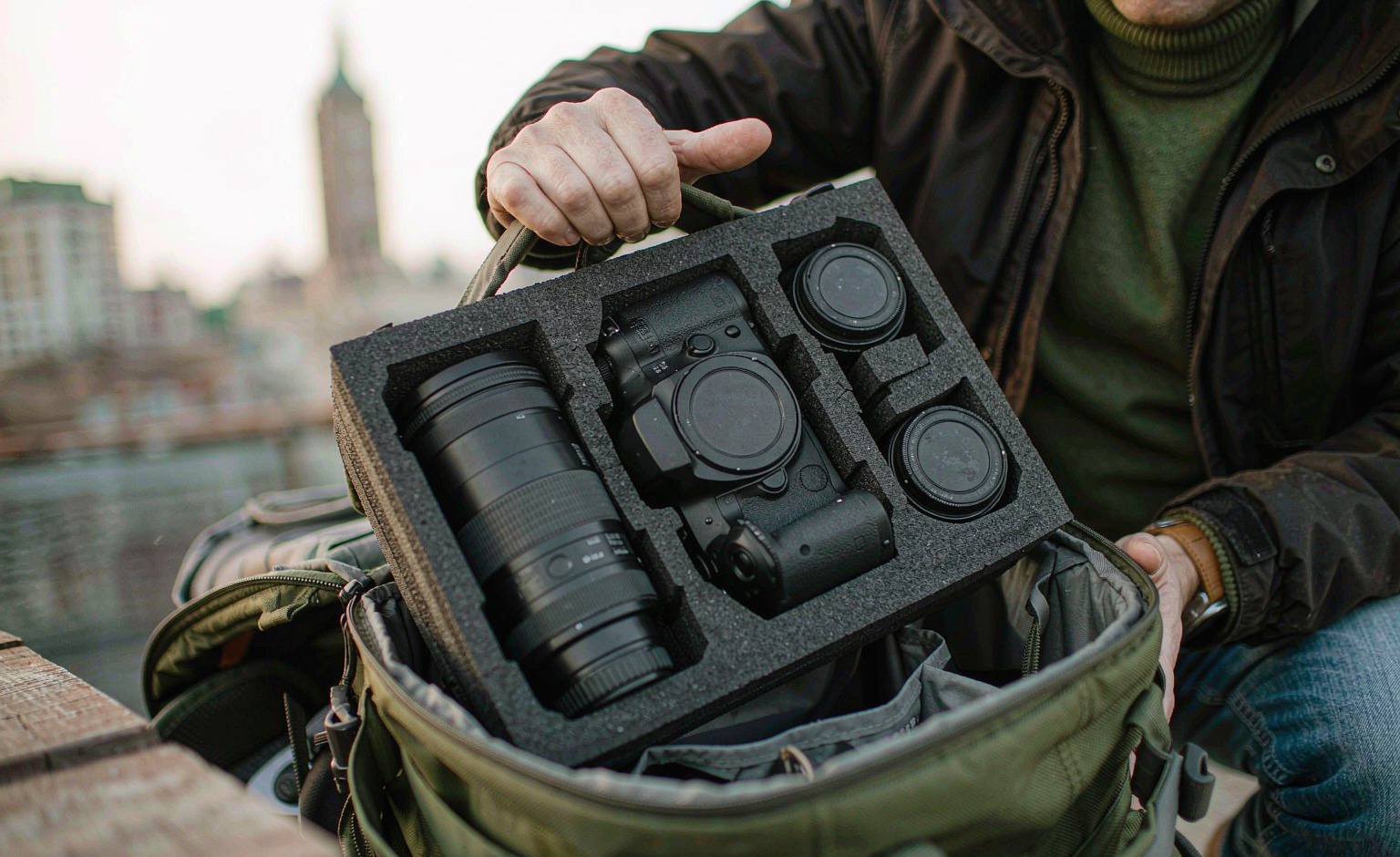
Size claim and capacity labelling starts with a written measurement protocol, because a litre figure is only defensible if the method that produced it is stated on the specification sheet. Three linear dimensions are taken on a defined configuration, volume is derived by one declared method, and the same protocol governs the label, the hangtag and the listing. The boundary is that mandated label content is destination-market dependent and is signed off by the customer with its broker or retailer; the measurement logic behind the number is what is controlled here.
What a Capacity Number Actually Measures
A litre figure is a claim about a void, and the first question is which void. There are three candidates in any bag: the internal cavity as filled, the geometric envelope of the closed bag, and the geometric envelope including every external pocket and attached module. Those three can differ by a wide margin on the same physical product, and a buyer comparing two brands is frequently comparing the first against the third without knowing it.
The honest starting point is the internal cavity: the space available to the user inside the closed main body, measured on a defined configuration. That is the number a buyer can test, and the number a returns department can check. Envelope arithmetic, by contrast, multiplies external height by width by depth and is necessarily larger than the usable cavity, because it counts the corner volumes that no packing fills and the thickness of the panels themselves.
Configuration has to be stated before measuring. A roll-top bag has a rolled and an extended configuration, and the difference can be several litres. A bag with compression straps has a compressed and an uncompressed state. A modular platform has a base configuration and a configuration with modules attached. Unless the specification names the configuration, two people measuring the same bag on the same day will report two different numbers and both will be right.
Selection rule: Declare the cavity you are measuring, the configuration it is measured in, and the method used, on the specification sheet before the first sample is built, because a litre figure without those three cannot be defended against a customer measurement.
Three Ways to Derive a Litre Figure Compared
Three practical methods exist for turning a bag into a number, and they disagree in a predictable direction. Fill methods measure what the bag accepts. Geometric methods measure what the bag occupies. A brand that switches methods between seasons has not changed its product; it has changed its claim, and the change is visible to any buyer who owns both.
| Method | What it measures | Typical result and bias |
|---|---|---|
| Water or free-flowing fill to the closure line | The true cavity volume up to the fill line | Lowest figure; understates usable space where the bag bulges above the line |
| Ball, bead or granule fill with a measured container | Packable volume including corner fill | Middle figure; closest to what a user can actually pack |
| External dimension arithmetic on the closed envelope | The box the bag occupies | Highest figure; counts panel thickness and unusable corners |
The gap between the first and the third is the source of most of the confusion in this category. External arithmetic on a softly structured bag can exceed a fill measurement of the same bag by a substantial margin, because the arithmetic assumes a rectangular prism and the bag is neither rectangular nor rigid. On a framed pack with a taut panel the two figures converge; on an unstructured daypack they diverge.
Method choice should follow the claim the brand wants to make and the test the buyer can run. A brand prepared to publish its protocol can use either, and the credibility comes from publishing. A brand that uses external arithmetic on a soft bag while a competitor uses fill measurement will appear to offer 20 percent more capacity for the same physical size, and the appearance is an artefact of method rather than of design.
Whatever method is chosen, the protocol states the fill line, whether the bag is supported or hanging, whether pocket volume is included, and how many units are measured to set the declared figure. A single measurement on a single sample is an observation; three units measured by the written protocol is a specification.
Verdict: Choose ball or bead fill where the claim must match what a user can pack, choose water fill where a conservative published figure is wanted, and never switch between methods after a figure has gone to print.
Why Two Bags That Look Alike Can Differ by Twenty Percent on Paper
Two packs of the same apparent size arrive at a 24-litre and a 30-litre claim. Nothing is dishonest; four mechanisms produce the gap, and all four are design or method decisions rather than errors. Understanding them is what lets a buyer compare two claims fairly and lets a brand choose where it wants to sit.
The first is method, as above: one brand fills, the other multiplies external dimensions. The second is structural. A bag built from a stiff laminated panel with a flat back holds a shape close to a rectangular prism and genuinely uses more of its envelope; a bag built from soft fabric collapses inward and uses less of the box it occupies. The third is the panel and padding budget: thick back padding, a framed sheet and a padded base all consume cavity while adding nothing to the external size a shopper perceives. The fourth is pocket inclusion: a brand counting three external pockets into the total adds litres that a brand counting the main cavity alone does not.
A modular platform adds a fifth mechanism peculiar to it. Modules attached to the outside occupy volume that was never in the cavity, so a 30-litre base with a 4-litre module can be described as 30 litres, 34 litres, or "30 litres plus 4", and each description is defensible if the configuration is stated. The misleading version is the one that silently switches between them in the same listing.
The buyer-side consequence is that apparent size on screen is a poor predictor of the printed figure, and the printed figure is a poor predictor of what fits. The only comparable pair of numbers is two figures produced by the same protocol, which is why a brand that publishes its protocol wins the comparison even when its number is the smaller one.
Takeaway: Publish the protocol next to the number, because a smaller figure with a stated method beats a larger figure without one whenever a buyer compares two listings and can only verify one of them.
Linear Dimensions: Which Three Numbers and How They Are Taken
Three numbers — height, width and depth — appear on every listing, and the way they are taken is as variable as the litre figure. Height is taken on the closed configuration, on a supported bag, from the lowest point of the base to the highest point of the body; whether the carry handle or the lid is included has to be stated. Width is taken at the widest point, which is sometimes the body and sometimes an external pocket. Depth is the figure most often inflated, because a soft bag's depth depends entirely on whether it is measured flat, lightly filled or packed.
Two conventions resolve it. The first is to measure flat: the bag laid on a surface, lightly smoothed, with no deliberate filling, and the depth read as the natural profile. The second is to measure at a defined fill state, which is more honest for a soft bag but requires the fill state to be described. Whichever is used, one convention must govern the dimension graphic, the specification sheet and the marketplace listing; otherwise a buyer measuring a delivered bag against a figure taken in another state has a legitimate complaint.
| Dimension | Measurement state defined in the protocol | Ambiguity removed |
|---|---|---|
| Height | Closed configuration, supported, base to top of body; handle stated separately | Whether the handle or an extended collar counts |
| Width | Widest point including external pockets, bag flat on a surface | Whether pocket bulge is inside the figure |
| Depth | Natural profile of the empty bag, or a named fill state | Whether a soft body is measured flat or packed |
| Handle or strap drop | Measured under no load | Whether carry height is included in body height |
Rounding is where claims quietly drift. A measured 298 mm rounded to 300 mm is trivial; the same rounding applied to height, width and depth and then multiplied into a litre figure is not, because the errors compound. Rounding each dimension to the nearest 10 mm before arithmetic can move the derived volume noticeably on a large pack, so the protocol states whether the arithmetic is run on raw measurements or on published rounded figures.
Tolerance closes the loop. A sewn, soft product cannot hold a millimetre, and a specification that claims otherwise generates disputes that no inspection can settle. A stated tolerance band on each dimension, agreed with the brand and checked at inspection, is what makes a dimension check meaningful; the tolerance itself is a commercial decision and is set from the product's structure, not copied from another category.
Spec rule: State the measurement configuration and the fill state for all three dimensions, run volume arithmetic on raw rather than rounded measurements, and set a tolerance band per dimension before the specification sheet is issued.
Volume Against Payload: The Density Trap
Litres and kilograms are different claims and buyers conflate them constantly. A 35-litre pack will hold 35 litres of lofted clothing at roughly two to three kilograms and the same 35 litres of tools or water at fifteen kilograms or more. Capacity describes space; payload describes what the structure can carry, and the two are related only through the density of what is packed.
The practical consequence for a specification is that a capacity claim without a payload statement invites misuse. Where a bag is intended for dense loads — tools, batteries, survey instruments — the specification should carry a recommended working load in kilograms alongside the litre figure, and the load-bearing elements should be specified against that load. Where the intended load is light and bulky, the litre figure is the more useful claim and the payload line can be short.
Density also explains why a capacity comparison between two ranges can mislead. A hiking range designed around a lofted sleeping bag and a work range designed around hand tools can carry the same litre figure with completely different frame, webbing and seam specifications, because the load cases differ. Comparing litre figures across those two categories is comparing air.
This is also where the modular argument is made honestly. A modular platform's value is not that it carries more litres; it is that the same host bag serves a 3 kg camera load and a 9 kg tool load without repurchase, because the modules change the internal organisation rather than the volume. Claims built on litre counts alone miss the point of the platform, and a buyer reading only the litre figure will not see the difference.
Bottom line: Publish a recommended working load in kilograms next to the litre figure wherever the intended contents are dense, because capacity describes space and the structure is specified against weight.
Pockets, Modules and Extensions: What Counts Inside the Claim
Inclusion rules are the final variable, and they are the one that most often separates two honest claims. Four categories of space can be inside or outside the declared figure: external pockets, internal organisers, attached modules, and extension geometry such as an unrolled collar or an expanded gusset. Each must be assigned in the protocol, and the assignment must be the same on the label, the hangtag and the listing.
Two conventions work. The conservative convention declares the main cavity only and lists pockets and modules separately, which produces a smaller headline number and no disputes. The inclusive convention declares a system total with modules attached, which produces a bigger number and requires the base figure to be shown alongside it. What does not work is using the inclusive figure in the headline and the conservative figure in the specification sheet, because that is the version a buyer discovers.
Extension geometry needs its own line. A roll-top collar has a rolled height and an extended height, and the difference is real usable space that a user can access, so it is stated as a range or as two figures rather than folded silently into one. A compression system works in the opposite direction: a bag that compresses to a smaller envelope has a minimum and a maximum, and both are useful to a buyer choosing between two sizes.
Where a label or hangtag carries a figure, the space available on the artwork governs how much of this can be shown. A single litre number is usually all that fits, which is why the full protocol lives on the specification sheet and the listing rather than on the label. Mandated label content, including whether a capacity figure is required at all, is destination-market dependent and is settled by the customer with its broker or retailer.
Judgement: Assign every pocket, module and extension to inside or outside the declared figure in writing, show a system total only beside its base figure, and keep the full protocol on the specification sheet where there is room for it.
How to Choose a Measurement Protocol: A Sequence
The sequence below is the order in which these decisions constrain each other; taking them out of order means re-measuring a sample that has already been approved.
- Name the cavity being measured: internal cavity, external envelope, or envelope plus pockets.
- Name the configuration: rolled or extended, compressed or uncompressed, modules off or on.
- Choose the derivation method and state it in the protocol.
- Define the measurement state for height, width and depth, including fill state.
- Assign pockets, modules and extension geometry to inside or outside the figure.
- Measure at least three units and set the declared figure from the protocol, not from one sample.
- Set a tolerance band per dimension and record it on the specification sheet.
- Write the payload line in kilograms where the load case is dense.
- Reuse the same figure on label, hangtag, listing and dimension graphic, or state the relationship between them.
- Re-measure on the pre-production sample and again on first-off bulk units.
Step six is the one that separates a specification from an aspiration. A single sample can sit at the top of a tolerance band purely by chance; three units measured by the same protocol give a figure that a repeat order can be held to. Step ten is what protects the repeat: a first-off bulk unit measured against the approved sample catches a pattern change that has quietly moved the volume before 5,000 units are made.
Costs stay modest because the work happens inside sampling. A conventional sample takes 6-10 working days to build and the measurement set takes minutes per unit, so the whole protocol costs less than one reprint of a hangtag run.
Where the Figure Appears: Label, Hangtag, Listing and Inspection
One figure, four places, and the failure mode is divergence. The label carries whatever the destination market requires. The hangtag carries the commercial claim and usually has room for one number plus three dimensions. The listing carries the full story and should carry the protocol. The inspection record carries the tolerance check. If the four disagree, the disagreement surfaces as a return, and a return is the most expensive place to discover a specification error.
The dimension graphic deserves specific attention because it is the artefact buyers screenshot and compare. It must be generated from the same measurement set as the specification sheet, carry the configuration note if there is one, and be dated or versioned so an older graphic can be identified after a design change. A graphic produced from an early prototype and never updated is a standing misrepresentation.
Inspection is where the claim is defended. Dimensional checks are written into the inspection plan with the tolerance band from the protocol, and the lot is examined to AQL 2.5 following ISO 2859-1 with critical, major and minor classes assigned beforehand. A dimensional defect is then graded against a stated tolerance rather than against an opinion, and a repeat order is measured against the retained sample from the first.
There is a documentation layer behind all of this. Commercial invoices, packing lists and any origin or marking statements are checked by customs against the physical shipment, and the general trade framework is described by WTO, while market-specific export guidance is issued by the U.S. Department of Commerce. None of those sources prescribes your capacity figure; they matter because a shipment whose documents, marks and claims disagree creates questions that a correct measurement protocol alone will not answer.
Selection rule: Generate the label, the hangtag, the listing and the dimension graphic from one measurement set, version the graphic, and check dimensions at inspection against the tolerance band written into the protocol.
Programme Facts: Sampling, Tolerances and Repeat-Order Control
Our production team turns a conventional construction around in 6-10 working days and a complex one in 12-15, billing USD 50-150 for the sample and crediting it back once the order is placed, while fresh tooling, plates or screens cost USD 300-2,500. A reference is opened at 500 pieces, the production cycle runs 35-50 days, payment is T/T 30/70, and despatch is FOB Xiamen; onward transit is 25-35 days by sea, 5-8 days by air, or 3-5 days by express.
Floor capacity behind the programme is 4,950 m² of SGS-verified space holding 7 production lines, 149 machines and 137 people, rated at 200,000 pieces monthly; the founder's bag production experience dates to 2004 and the operation began in 2014. Dimensions are captured on the approved pre-production sample and recaptured on first-off bulk pieces, and the lot is examined to AQL 2.5 as set out in ISO 2859-1 with defect classes agreed before inspection starts. Freight planning assumes 28 CBM for a 20GP and 68 CBM for a 40HQ.
Practical scope: the measurement protocol, the tolerance band and the repeat-order comparison are controlled inside the programme. Whether a capacity figure or any other element is mandated on the label in a particular market is destination-market dependent, and the customer resolves it directly with its broker or retailer for that market; the measurement logic here supports whatever claim the market asks for rather than replacing it.
Related reading: fibre content labelling, hangtag and care label content, and writing a bag specification sheet. Capacity figures for the current platform range are on the product page, and protocol questions can go to the enquiry desk. Sizing across the hiking range is described on the modular hiking pack page.
Bottom line: Take three measurements by one written protocol, publish the protocol beside the figure, and re-measure first-off bulk against the approved sample, because a capacity claim is defended by its method and not by its number.
Frequently asked questions
What does a bag capacity figure actually measure?
Whichever cavity the protocol names: the internal cavity as filled, the closed external envelope, or the envelope plus pockets and modules. The three differ substantially on the same bag, so the specification sheet must name which one is being declared and in what configuration it was measured.
Why do two similar-looking bags have different litre ratings?
Method, structure, padding budget and pocket inclusion. One brand may fill and another may multiply external dimensions; a soft shell uses less of its envelope than a stiff one; thick padding consumes cavity; and external pockets may or may not be counted.
Which method gives the most defensible litre figure?
Ball or bead fill measured into a calibrated container, because it approximates what a user can actually pack. Water fill to the closure line gives a conservative figure; external dimension arithmetic gives the highest and counts corner volume a packer never uses.
Should external pockets be included in the capacity claim?
Only if the protocol says so and the base figure is shown beside the total. The conservative convention declares the main cavity and lists pockets separately, which produces a smaller headline and no disputes with a buyer who measures the bag.
How should height, width and depth be measured on a soft bag?
On a defined state: laid flat and lightly smoothed with no deliberate filling, or at a named fill state. State which, and apply it to the specification sheet, the dimension graphic and the listing, or a buyer measuring a delivered bag has a legitimate complaint.
How many units should be measured before declaring a figure?
At least three, measured by the same written protocol. One sample can sit at the top of a tolerance band by chance, and a figure taken from it cannot be held against a repeat order. Sample turnaround is 6-10 working days, so the measurement set fits inside it.
Does a roll-top bag have two capacity figures?
Effectively yes: a rolled figure and an extended figure, and the gap is real usable space. Publish a range or two numbers rather than folding both into one, and state which configuration the photograph and the dimension graphic show.
What tolerance should be allowed on stated dimensions?
A sewn soft product cannot hold a millimetre, so a band per dimension is set from the product's structure and written into the specification sheet. Dimensional checks are then graded against that band at AQL 2.5 rather than against an opinion.
Is capacity the same as how much weight a bag can carry?
No. Litres describe space and kilograms describe what the structure carries. Thirty-five litres of lofted clothing weighs two to three kilograms; the same volume of tools or water can exceed fifteen. Publish a working load in kilograms for dense loads.
Should a modular system count its modules in the litre figure?
Decide and state it. A 30-litre host with a 4-litre module can be written as 30, 34, or 30 plus 4, and each is defensible if the configuration is named. The misleading version switches between them inside one listing.
How does rounding affect a derived volume figure?
It compounds. Rounding each dimension to the nearest 10 mm before arithmetic shifts the derived volume noticeably on a large pack, so the protocol states whether arithmetic runs on raw measurements or on published rounded ones.
Where should the measurement protocol be published?
On the specification sheet and the listing, where there is room for it. A label or hangtag usually fits one number plus three dimensions, which is why the protocol lives in the longer documents and the shorter ones carry a consistent figure.
Can a capacity figure be checked at inspection?
Yes, where a tolerance band is written into the protocol and dimensional checks are in the inspection plan. The lot is examined to AQL 2.5 under ISO 2859-1 with defect classes agreed beforehand, and first-off bulk units are measured against the approved sample.
How much does it cost to set up a measurement protocol?
Little beyond sampling time. A conventional sample is ready in 6-10 working days and each measurement pass takes minutes per unit, which is far less than reprinting a hangtag run or fielding a wave of size complaints.