Home › Field notes › Product Photography Spec for Catalogues: Angle List, Light Plan, Scale
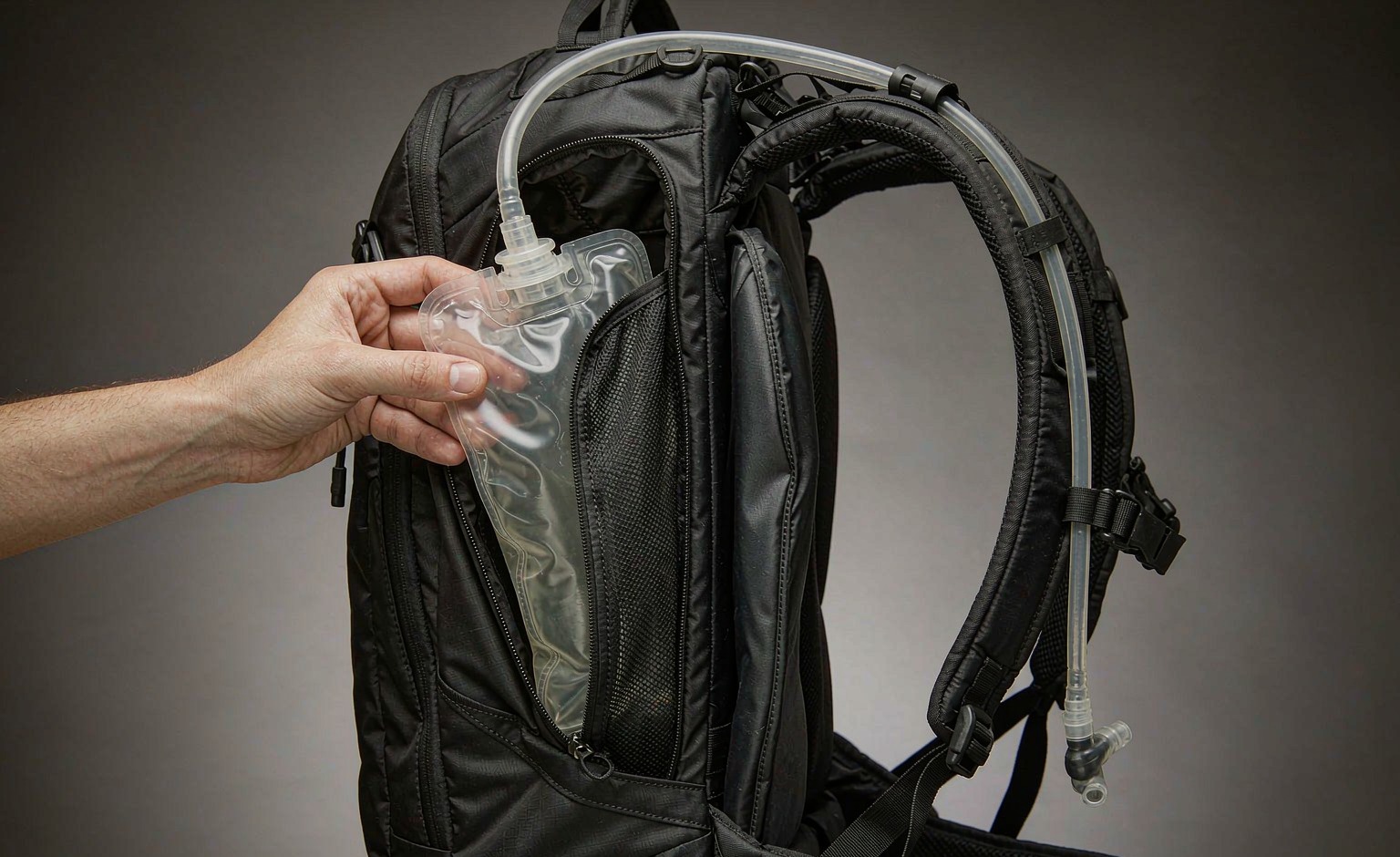
A product photography spec for catalogues is a written standard that fixes the angle list, the light plan, the scale reference and the file delivery format before any shoot begins, so one shoot serves print, retail and marketplace channels without a reshoot. A standard set is twelve hero frames, six detail frames and three scale frames per reference, produced at 6,000 pixels on the long edge and delivered in sRGB at 300 dpi. The boundary is that this page covers commercial catalogue imagery for civilian load carriage: it makes no claim about any regulated label content, which stays destination-market dependent and is confirmed with your broker or retailer.
What a Photography Specification Has to Lock Before the Shoot
Photography goes wrong in a predictable order. The shoot happens, the images look good on a screen, and then the retail team asks for a square crop, the marketplace asks for a white background at a fixed pixel count, the print catalogue needs 300 dpi at a different aspect ratio, and the e-commerce team needs a scale reference that was never shot. None of those requests is unreasonable; all of them are unanswerable from a shoot that was specified by eye. Two thirds of reshoot cost in a bag programme comes from missing frames rather than from bad frames.
The specification exists to close that gap. It states, in writing and before the booking: which frames exist, at what camera geometry; what background and light setup produces them; how scale is communicated; how colour is controlled and checked; and what files are delivered, named and archived. With those five clauses agreed, a shoot for eight references produces eight comparable sets, and a reference added next season can be shot to the same standard by a different studio and still sit correctly beside the old ones.
Comparability is the actual product. A buyer comparing three bags in a grid is reading relative size, relative colour and relative feature density from the images alone. If the light direction changes between two references, the panels read as different materials; if the camera height changes, the volumes read as different sizes. A specification that fixes geometry is what makes a catalogue grid legible, which is a commercial property and not an aesthetic preference.
Selection rule: Write the five clauses — frames, background and light, scale, colour control, file delivery — into the brief before the studio is booked, because a reshoot costs more than the shoot and almost always stems from a missing clause rather than a bad photograph.
The Angle List: Which Frames Every Reference Must Have
An angle list is a shot inventory, and it is the single most useful artefact in the whole specification. It converts "get some good shots of the bag" into a countable set that can be checked off on the day, reused next season and audited when a channel asks for a frame that does not exist. Twelve hero frames cover a modular platform; six detail frames answer the questions that otherwise arrive as pre-sale emails; three scale frames let a buyer judge size without a tape.
Camera geometry is the part that must be written rather than left to the photographer's judgement. Fixed camera height relative to the bag's centre, a fixed distance, and a fixed lens choice across the set mean that apparent size differences between two references are real differences and not perspective artefacts. A 50 mm lens at roughly 2 m on a full-frame body gives a natural perspective for a backpack; wider than about 35 mm exaggerates depth and makes a 30-litre bag read like a 45-litre one.
| Frame | Purpose in the catalogue | Camera geometry and framing | Naming token |
|---|---|---|---|
| Front three-quarter hero | Primary grid image and cover frame | 50 mm, eye level to the bag centre, 15 percent margin | 01-hero-3q |
| Front flat-on | Symmetry check and front-panel branding | 50 mm, camera square to the panel, no convergence | 02-front |
| Back panel and harness | Shows strap geometry and contact surface | 50 mm, square to the back panel | 03-back |
| Left and right profile | Depth judgement | 50 mm, square to each side, same distance as hero | 04-side-l / 05-side-r |
| Base | Foot design and base reinforcement | Camera above, square to the base plane | 06-base |
| Top-down opening | Mouth geometry and access | Camera directly above, bag upright | 07-top |
| Main compartment open | Interior capacity read | 45 degrees above, compartment fully open | 08-open |
| Module separated | Shows the modular claim | Three-quarter, module 150 mm from the host bag | 09-module-off |
| Module attached | Shows the assembled system | Three-quarter at the hero geometry | 10-module-on |
| Packed interior | Capacity credibility | 45 degrees above, standard load in place | 11-packed |
| Worn front and worn back | Scale on a body | Full height, 50 mm, model at the marked floor line | 12-worn-f / 13-worn-b |
| Attachment grid close-up | Row count and spacing legible | Macro, square to the panel, scale card in frame | 14-grid |
The naming token column is not administrative detail. Delivery folders containing IMG_2841.jpg force the e-commerce team to open every file to find the base frame, and that handling time is the reason a correct set sometimes ships with the wrong hero. Tokens that sort numerically also mean a missing frame is visible as a gap in the sequence rather than discovered on the listing page.
Verdict: Fix one lens and one camera-to-subject distance across the whole set so apparent size differences are real, and name every frame with a numeric token so a gap in the sequence is visible before delivery.
Background and Light Plan Compared: Which Setup Serves Which Channel
Background and light are one decision, not two. The background choice is driven by the channel that will consume the image — a marketplace usually requires a pure white field, while a print catalogue or a brand lookbook can carry a context — and the light plan is then built to light that background and the product consistently. Choosing a look first and discovering later that the marketplace rejects it is the expensive version of this decision.
| Criterion | Seamless white sweep | Light grey sweep | In-context or on-body |
|---|---|---|---|
| Marketplace acceptance | Highest; meets white-background rules directly | Usually needs clipping to white first | Rarely accepted as the primary frame |
| Colour fidelity | Good; risk of underexposed shadows at the base | Best; gives the meter a mid-tone reference | Variable; mixed light sources shift hue |
| Shadow behaviour | Soft contact shadow; can look floaty | Natural grounded shadow | Depends entirely on location |
| Setup time per reference | About 20-30 minutes | About 25-35 minutes | One to three hours with a model |
| Repeatability next season | High; fully controlled | High; fully controlled | Low; location, weather and model change |
| Best use | Grid images, listings, spec sheets | Print catalogue and brand pages | Cover, campaign and worn-scale frames |
Light position follows from the material. A coated nylon shell is specular: a single hard source at 45 degrees produces a highlight that reads as a wet patch and hides the weave, so a large diffused source is used and the fill is raised to hold detail in the shadow side. A textured or uncoated fabric tolerates more directional light, which is what gives a ripstop or an Oxford weave its visible structure. Where a reference has both — a coated base panel and an uncoated front panel — the light is set for the more difficult surface and the easier one is left slightly under-lit rather than blown.
Colour control closes the plan. Capture at a fixed white balance rather than automatic, shoot a colour reference card at the head of every setup change, and check the result on a calibrated display under the viewing conditions described in ISO 3664. A studio that changes white balance between two references has produced two different products as far as the buyer's eye is concerned.
Takeaway: Shoot the grid frames on a seamless white sweep with one large diffused source and a raised fill, keep white balance fixed across the whole set, and reserve in-context frames for campaign use only.
Scale Reference: Letting a Buyer Judge Size Without a Tape
The most common pre-sale question on any bag listing is "how big is it really", and it is a question about the photograph, not about the specification. Three devices answer it, and a serious shoot uses all three. The first is a worn frame on a model of stated height standing on a marked floor line. The second is a scale object in frame — a 500 ml bottle, an A4 document, or a laptop of stated screen size. The third is a dimension graphic carrying the actual measured height, width and depth.
The scale object has to be chosen deliberately. An A4 sheet works internationally because the format is defined by ISO 216 at 210 x 297 mm and is recognisable in every market; a 500 ml bottle is recognised but varies in proportion between brands; a laptop is the most useful object for a work bag and the least useful for a hiking pack. Whatever is chosen must appear at the same size and position in every frame that uses it, or it stops functioning as a reference.
Dimension graphics are the fallback that never fails, and they carry a risk. The numbers on the graphic must come from the same measurement protocol as the numbers on the specification sheet and the listing, because a buyer who measures the delivered bag and finds a 20 mm difference has a complaint that no photograph can answer. Where the pack has a roll-top or a compression system, the graphic states which configuration was measured.
Scale also has to survive cropping. A marketplace square crop takes the sides off a 3:2 frame, so the scale object must sit within the central square rather than at the edge, and the dimension graphic must not be placed in the outer 10 percent. This is the kind of clause that costs nothing at the shoot and saves a complete re-edit.
Spec rule: Give every reference one worn frame at a stated model height, one frame with a fixed scale object inside the central square, and one dimension graphic sourced from the same measurement protocol as the specification sheet.
Detail Frames: The Six Close-Ups That Stop Pre-Sale Questions
Hero frames sell, detail frames close. Six close-ups answer the questions that otherwise arrive as emails, chat messages and returns: what the closure is, how the attachment grid is built, how the load seams are finished, what the hardware is, how the webbing is anchored, and what the interior surface is like. Each is shot square to the subject with a scale card or a coin in frame, because a close-up without scale is a texture image and answers nothing.
| Close-up | Pre-sale question it answers | Framing rule |
|---|---|---|
| Zip and slider | Is it a branded coil or a generic chain, and is there a garage | Square to the tape, slider at frame centre, scale card in corner |
| Attachment grid | How many rows, and at what spacing | Square to the panel, three rows minimum in frame |
| Bar tack at a load point | Is the webbing anchored or just stitched through | Macro, square to the stitch block, fill light from one side |
| Hardware: buckle or hook | Release mechanism and material | Three-quarter at 30 degrees, mechanism visible |
| Interior lining and seam | Is the lining bonded, taped or plain | Top-down into the compartment, corner seam in frame |
| Back panel and strap contact | Padding thickness and facing material | Profile view, strap edge against a neutral card |
Two of the six carry specification claims. The attachment grid close-up is where a buyer counts rows and judges whether third-party pouches will fit, so the frame has to be square to the panel and lit to show every row rather than the top three. The bar tack close-up is where a buyer judges durability; it is also the frame most often shot badly, because a macro image of a stitch block without side fill reads as a dark smudge.
Detail frames are also the cheapest insurance against a return. A customer who has seen the actual slider, the actual grid and the actual seam finish has a far more accurate expectation than one who has seen three hero shots, and expectation accuracy is what return rates are made of. Six frames per reference is roughly half an hour of studio time against a return that costs several times the unit margin.
Bottom line: Shoot six detail frames per reference square to the subject with a scale card in frame, and treat the attachment grid and the load-point bar tack as specification evidence rather than decoration.
File Delivery: Resolution, Colour Space, Naming and Archive
Delivery is where a good shoot becomes a usable asset or an unusable one. The clause has five parts. Capture: raw plus a 6,000-pixel long-edge JPEG at the highest quality setting, because a 6,000-pixel file crops to a marketplace zoom and to a print quarter-page without interpolation. Colour: sRGB for all delivered files, since a file left in a wider gamut renders flat and desaturated in a browser that assumes sRGB. Print: a 300 dpi TIFF or high-quality JPEG at the final trim size for catalogue pages. Naming: the numeric token sequence from the angle list. Archive: one folder per reference per season, with the raw files retained.
Crop ratios are stated in the clause rather than discovered later. A 3:2 master crops to 4:5 for a marketplace grid, 1:1 for a thumbnail, and 16:9 for a web banner, and the composition must survive all three — which is why the hero frame is shot with roughly 15 percent margin around the subject. A hero framed edge to edge cannot be cropped to square without losing the base or the top of the bag.
Retouching rules belong in the clause too. Dust, stray threads and a handling crease are removed; the material texture, the stitch line and the panel geometry are not. A retouched image that smooths a weave or straightens a panel edge is a misrepresentation of the product, and it is the kind of misrepresentation a buyer discovers on delivery and reports as a quality complaint. Where a colour correction is applied, it is applied to match the physical reference under the viewing conditions already agreed, not to make the image prettier.
Archive discipline is what makes the next season cheap. One folder per reference, named by reference code and season, holding the raw capture, the retouched master and the channel derivatives, means a repeat order needs no reshoot at all and a new colourway can be dropped into an existing set. Programmes that skip this pay for the same frames twice.
Judgement: Deliver a 6,000-pixel sRGB master plus a 300 dpi print file per frame, keep roughly 15 percent margin in the hero composition, and archive one folder per reference per season so a new colourway needs no reshoot.
Why One Standard Set Serves Every Downstream Channel
The economic case for a written standard is simple and it compounds. A shoot produces frames; every downstream channel consumes a derivative of those frames. Print wants 300 dpi at trim size, the retail grid wants a square crop on white, the marketplace wants a fixed pixel count and a zoom layer, the sales team wants a PDF spec sheet, and the distributor in another country wants the same set with translated callouts. One well-specified shoot produces all of these; five ad-hoc shoots produce five incompatible sets and no single source of truth.
Consistency across seasons is the larger prize. A brand that shoots to a fixed standard can add a reference two years later and have it sit correctly beside the originals, because the camera geometry, the light plan and the background are all recorded. A brand that shoots by eye has to reshoot the whole range whenever the catalogue is reformatted, which is a recurring cost that never appears in the unit price and always appears in the marketing budget.
There is a procurement angle as well. Imagery is produced from a pre-production sample, which is the same physical artefact the brand approves before bulk begins, so a written photography clause is naturally attached to the sampling gate: the sample is approved, the frames are shot to the standard, and the bulk run is then compared against both. Where imagery is shot from an early prototype instead, the catalogue can show a detail that the production unit does not have, which is a specification dispute waiting for a customer.
Trade documentation and listing content sit behind all of this. Marketplace and retail onboarding asks for imagery, dimensions and description together, and export-facing guidance on product content is published by the U.S. Department of Commerce. The images do not satisfy a labelling rule, and they do not remove the need to confirm label content for the destination market; what they do is remove the delay between having an approved sample and being able to list it.
Selection rule: Attach the photography clause to the pre-production sample gate rather than to the marketing calendar, because the sample is the artefact the imagery must match and the only point at which a discrepancy can still be corrected.
How to Choose a Photography Specification: A Sequence
The order below is the order in which the decisions constrain each other; reversing it costs studio time.
- List the channels that will consume the imagery and their hard requirements: background, pixel count, aspect ratio.
- Fix the angle list, including the numeric tokens, and count the frames per reference.
- Choose the background and light plan from the strictest channel requirement, not from the nicest reference image.
- Fix lens, camera height and distance for the whole set; record them in the brief.
- Set the scale devices: model height and floor line, scale object, dimension graphic source.
- Set colour control: fixed white balance, reference card at every setup change, ISO 3664 viewing conditions.
- Write the delivery clause: master size, colour space, crop ratios, naming, archive structure.
- Write the retouching rule: remove contamination, never remove texture or geometry.
- Shoot from the approved pre-production sample, not from a prototype.
- Check delivery against the angle list before the studio is paid; a gap in the token sequence is a reshoot.
Step one is the one that changes the most. A brand selling only through its own site has one set of constraints; a brand listing on three marketplaces and supplying two retail chains has three or four, and the strictest one governs the hero frame. Establishing that before the shoot is a half-day of reading routing guides against several weeks of re-editing afterwards.
Step ten is the one that is skipped under deadline. The delivered folder is checked against the angle list on the day, while the set is still assembled and the studio still has the reference on the stand. A gap found a month later means rebooking the studio, re-lighting the set and matching a background that has since been repainted.
Programme Facts: Sampling, Capacity and the Sample the Camera Sees
On the production side, a pre-production sample is built in 6-10 working days for a conventional construction and 12-15 working days where the build is complex, with a sample charge of USD 50-150 that is credited against the order; new tooling, plates or screens run USD 300-2,500. Each reference opens at 500 pieces, the build window is 35-50 days, settlement is T/T 30/70, and goods move FOB Xiamen with sea transit of 25-35 days, air of 5-8 days, or courier of 3-5 days.
The 4,950 m² SGS-verified production floor we work with carries 7 production lines and 149 machines, staffed by 137 people and rated at 200,000 pieces a month; our founder has been in bag production since 2004, and the business dates from 2014. The unit presented to the camera is the approved pre-production sample, and bulk is then checked against it to AQL 2.5 following ISO 2859-1 with critical, major and minor classes agreed in advance. Container planning runs on 28 CBM for a 20GP and 68 CBM for a 40HQ.
Practical scope: imagery is a commercial asset, and the studio clause, the angle list and the delivery format are controlled inside the programme. Regulated label content shown in any frame remains destination-market dependent, and the customer settles it with its own broker or retailer; the photography clause deliberately does not extend to what a label must say.
Related reading: size claims and capacity labelling, the specification sheet template, and the tech pack for a modular platform. Platform options sit on the product page, and sample or imagery scheduling can be raised with the enquiry desk. Modular attachment geometry is described on the MOLLE system page.
Bottom line: Shoot the approved pre-production sample to a written clause, deliver a 6,000-pixel sRGB master per frame, and check the delivered folder against the angle list on the day, because every one of those three costs less than the cheapest reshoot.
Frequently asked questions
What should a product photography spec for catalogues include?
Five clauses: the angle list with numeric tokens, the background and light plan, the scale devices, the colour control method, and the file delivery format. Written before the studio is booked, those five prevent the reshoot that most bag programmes end up paying for. Expect twelve hero frames plus six detail frames per reference.
How many angles does a bag reference need in a catalogue?
Twelve hero frames, six detail frames and three scale frames. The hero set covers front three-quarter, front, back, both profiles, base, top-down, open compartment, module off, module on, packed interior and worn front and back, plus one attachment grid close-up.
Which lens should be used for bag catalogue photography?
A 50 mm lens at roughly 2 m on a full-frame body gives natural perspective for a backpack. Wider than about 35 mm exaggerates depth and makes a 30-litre pack read like a 45-litre one. Fix one lens and one distance across the whole set so size differences between references are real.
Why does a white background matter for marketplace listings?
Most marketplaces require a pure white primary frame and reject grey or in-context images at onboarding. Shoot hero frames on a seamless white sweep with a large diffused source and raised fill, then reserve in-context frames for campaign use, so no re-edit is needed to list.
How do you show the size of a bag in a photograph?
Three devices: one worn frame on a model of stated height at a marked floor line, one frame with a fixed scale object such as an A4 sheet at 210 x 297 mm, and one dimension graphic taken from the same measurement protocol as the specification sheet.
What resolution should catalogue images be delivered at?
A 6,000-pixel long-edge sRGB master per frame plus a 300 dpi print file at trim size. Six thousand pixels crop to a marketplace zoom and a print quarter-page without interpolation, and sRGB prevents the flat, desaturated look a wider gamut file produces in a browser.
Which detail close-ups reduce pre-sale questions the most?
Six: zip and slider, attachment grid, bar tack at a load point, hardware mechanism, interior lining and seam, and back panel with strap contact. Shoot each square to the subject with a scale card in frame, or the close-up becomes a texture image that answers nothing.
How is colour kept consistent between two shoots a season apart?
Fix white balance rather than using automatic, shoot a colour reference card at every setup change, and review on a calibrated display under the viewing conditions in ISO 3664. Record camera height, distance and light positions so the second shoot reproduces the first.
Should photography be shot from a prototype or a pre-production sample?
From the approved pre-production sample. A prototype can show a detail the production unit does not have, which becomes a specification dispute once customers receive the goods. Sampling runs 6-10 working days, so the sample is available before the studio booking is needed.
How much margin should a hero frame leave for cropping?
Roughly 15 percent around the subject. A 3:2 master crops to 4:5, 1:1 and 16:9, and a hero framed edge to edge loses the base or the top when it is squared. Keep scale objects and dimension graphics out of the outer 10 percent of frame.
What retouching is acceptable on a product photograph?
Remove dust, stray threads and handling creases. Never smooth a weave, straighten a panel edge or alter stitch geometry, because that misrepresents the product and a buyer discovers it on delivery. Colour correction should match the physical reference, not flatter the image.
How should catalogue image files be named and archived?
Numeric tokens that sort in sequence, such as 01-hero-3q through 14-grid, one folder per reference per season holding raw capture, retouched master and channel derivatives. Correct naming makes a missing frame visible as a gap rather than as a surprise on the listing.
How much studio time does a standard bag reference take?
A seamless white setup runs about 20-30 minutes per reference once the set is lit, with roughly half an hour more for the six detail frames. In-context or on-body work takes one to three hours with a model and is far less repeatable between seasons.
Can one shoot serve print, retail and marketplace channels?
Yes, provided the strictest channel governs the hero frame and the delivery clause states every required derivative. One well-specified shoot produces print files at 300 dpi, square marketplace crops and zoom layers; five ad-hoc shoots produce five incompatible sets.